How to Secure AI Agents in the Enterprise: Visibility, Governance & Risk Control
.avif)
What are AI Agents in the Enterprise?
AI agents are software tools that use large language models and other AI capabilities to perform tasks autonomously across enterprise systems. Instead of simply responding to prompts, agents can plan actions, retrieve information, interact with APIs or SaaS tools, and execute workflows on behalf of users.
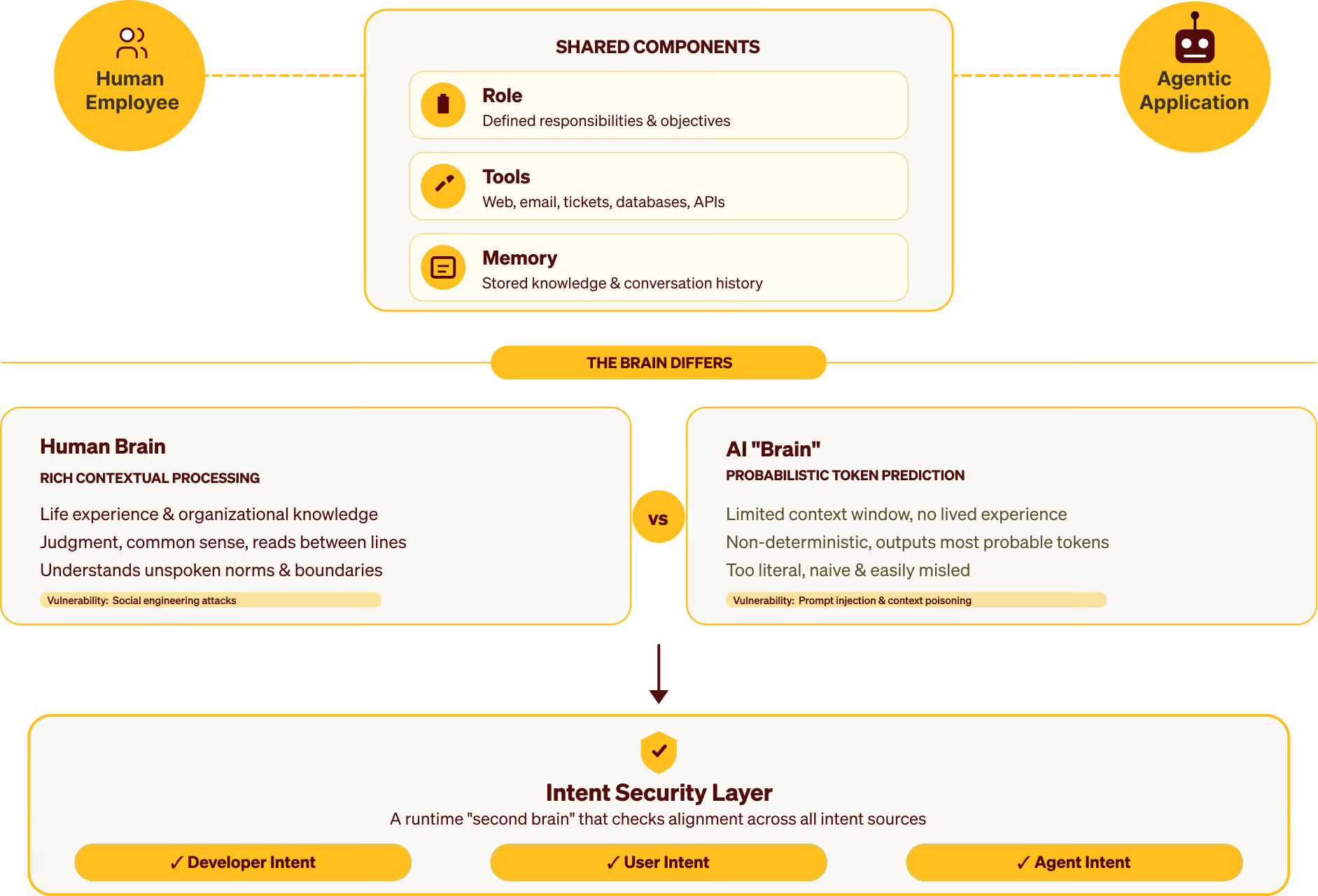
This shift introduces new security considerations. Unlike traditional automation, which follows deterministic rules (“if X, then Y”), AI-driven systems operate probabilistically and dynamically, making their behavior harder to predict and monitor.
Understanding how AI agents differ from traditional automation is essential for designing effective security controls for the modern enterprise.
AI Agents Vulnerabilities and Traditional Automation Security
Why Securing AI Agents Matters for Enterprises
Enterprise Data Already Flows Into AI Tools: 20% of Uploaded Files Contain Corporate Secrets
AI agents routinely access internal knowledge bases, SaaS platforms, and APIs to complete tasks. This risk is already visible in enterprise GenAI usage. Research has found that over 4% of prompts and more than 20% of files uploaded to AI tools contain sensitive corporate data.
Expansion of the AI Attack Surface
Unlike traditional automation, agents can execute multi-step workflows autonomously, chaining together actions across different tools and data sources. This creates complex interaction paths that attackers may manipulate through prompt injection or adversarial inputs.
Compliance and Governance Pressure
Regulators and security frameworks are increasingly focused on AI accountability. Systems that access sensitive data or influence decisions must meet evolving governance standards such as NIST AI RMF, ISO 42001, and GDPR-aligned data protection requirements.
Limited Visibility Into Agent Activity
AI agents make dynamic decisions based on prompts, retrieved data, and context. As a result, their behavior can be difficult for security teams to monitor using traditional logging and monitoring tools. This visibility gap is already becoming obvious across organizations. One survey found that only 54% of enterprises fully understand what data their AI agents can access, and just 44% have formal governance policies in place.
Despite this lack of oversight, agents are being deployed to perform tasks within the enterprise. Gartner projects that 40% of enterprise applications will include task-specific AI agents by the end of 2026, up from less than 5% in 2025.
Common enterprise use cases include:
- Customer support: Autonomously handling transactions like rebooking, refunds, and ticket triage.
- Finance & lending: Orchestrating underwriting, compliance checks, and CRM updates to compress loan processing cycles.
- Meeting workflows: Capturing action items, drafting follow-ups, and tracking accountability.
- IT & cybersecurity: Monitoring network traffic and system logs, triaging and responding to threats in real time.
- Supply chain: Monitoring supplier performance, forecasting demand, and adjusting inventory across locations.
- Product development: Balancing competing variables like cost, quality, and time-to-market.
- Healthcare: Analyzing medical literature and surfacing relevant research for clinical and R&D teams.
- HR & onboarding: Automating document processing, approvals, and cross-system updates.
Common and Emerging Security Risks in Enterprise AI Agents
On the surface, security teams often focus on preventing sensitive data from leaving the organization. However, the reality with AI applications is far more complex. Beyond traditional data protection, AI introduces deeper operational risks that can impact how agentic systems behave and make decisions.
These include system integrity issues and configuration drift, business process fraud and policy violations driven by automated actions, cascading failures across interconnected automations, and ultimately damage to reputation and customer trust.
Securing AI therefore requires looking beyond data leakage to the broader operational risks created by autonomous and semi-autonomous systems as they introduce enterprises with a new attack surface.
Prompt Injection and Adversarial Manipulation
Prompt injection is one of the most widely documented attack vectors against generative AI. Instead of exploiting a software bug, attackers manipulate the instructions an AI agent receives in order to alter its behavior.
Malicious instructions sent to an agent could manipulate the agent’s reasoning process, making it drift from his intent behaviors, and trigger data exfiltration or perform unwanted acts across connected enterprise systems.
This type of attack is particularly dangerous because it doesn’t require traditional exploitation techniques. Instead, it targets the decision-making layer of the AI system itself, turning the agent’s intelligence into the attack vector.
Excessive Permissions and Access Sprawl
Agents are often granted permissions across multiple systems such as CRM platforms, messaging tools, document repositories, analytics databases, or ticketing systems. That effectively turns them into privileged bridges between those environments. A compromised prompt or manipulated input could cause the agent to retrieve sensitive data, modify records, or execute unintended actions across multiple platforms.
This access sprawl is driving the gradual accumulation of privileges across interconnected systems. Without strict identity-aware controls and least-privilege policies, agents can become one of the most powerful (and least monitored) entities inside an organization’s infrastructure.
Sensitive Data Leakage Through Agentic Tools and Integrations
Enterprise agents rarely operate in isolation. They typically connect to knowledge bases, vector databases, SaaS tools, APIs, and internal documentation systems to retrieve the information needed to complete tasks.
If an agent retrieves data from a compromised source or misinterprets access permissions, sensitive information may surface in generated responses or be passed to downstream tools. In large environments where agents connect dozens of services together, a single misconfigured integration can expose information far beyond its intended scope.
Compromised APIs and External Connections
When an agent calls an API to retrieve information or execute a task, it effectively acts as a bridge between internal systems and external services. If those integrations are not properly secured, attackers may be able to manipulate how the agent interacts with them.
The OWASP Top 10 for Agentic Applications identifies insecure plugin or tool design as a major emerging risk. Because AI agents can autonomously invoke external services, a malicious prompt could cause the model to call a connected plugin with unintended parameters or retrieve sensitive data from connected systems.
Access and Identity Management
Perhaps the most fundamental challenge in securing AI agents is identity management. Traditional systems assume that actions are performed either by a human user or a clearly defined service account. That’s a distinction that AI agents blur.
Agents often act on behalf of users while also interacting with multiple tools and systems autonomously. In many enterprise environments, they inherit identity permissions from corporate identity providers, allowing them to retrieve documents, query internal databases, or execute actions within business applications.
This makes identity-aware access controls, permission segmentation, and continuous monitoring essential components of any AI agent security strategy.
Types of AI Agents That Introduce Security Risks
Workflow automation agents with SaaS access
Workflow automation agents are designed to connect multiple SaaS tools and automate routine business processes. They can approve requests, update records, send messages, or trigger actions across platforms like Slack, Salesforce, Google Workspace, or Jira.
The sales ops agent that accidentally broadcasts your CRM data to Slack
Picture a sales operations agent that monitors incoming leads, enriches them using external APIs, creates records in the CRM, and alerts the appropriate sales rep in Slack. To function properly, the agent may require access to the CRM database, messaging tools, analytics dashboards, and email systems.
The security risk emerges when the agent inherits broad permissions across these systems. If a malicious prompt or manipulated input triggers unintended behavior, the agent could retrieve internal records, send sensitive information to unauthorized channels, or modify system data at scale. Because these workflows often run autonomously, the activity may continue long before security teams notice the anomaly.
Research and Data Retrieval Agents
Research agents are designed to gather information from internal knowledge bases, document repositories, and external sources to answer complex questions or compile reports.
A research bot starts leaking confidential strategy while drafting a report
For instance, an internal strategy team might deploy a research agent connected to a company’s document management system, product roadmap repository, and financial data warehouse. When asked to generate a competitive analysis, the agent retrieves internal presentations, historical sales reports, and market research data before summarizing the findings.
The challenge is that retrieval-based systems tend to treat trusted internal sources as safe by default. If an attacker manages to manipulate a query through prompt injection, the agent could expose sensitive information or follow hidden instructions embedded in the retrieved content. In this way, the retrieval layer becomes an indirect entry point into the organization’s data ecosystem.
Customer Interaction Agents
Customer interaction agents power chatbots, virtual assistants, and support systems that engage directly with external users. These agents often connect to backend systems to retrieve order details, account information, or service history in real time.
Your customer support chatbot gets social-engineered into revealing account data
Consider a customer support agent integrated with an e-commerce platform. A user asks about the status of an order, and the agent retrieves shipping data, account records, and product information before generating a response.
Because these agents interface with external users, they are especially exposed to adversarial prompts and social engineering attempts. An attacker might attempt to manipulate the chatbot into revealing internal system details or performing actions beyond its intended scope. Even subtle prompt manipulations can cause the agent to bypass safeguards if the underlying controls are not carefully designed.
Developer and Engineering Agents
Developer agents assist engineering teams by generating code, reviewing pull requests, suggesting fixes, and automating development workflows. They are often integrated directly into repositories, CI/CD pipelines, and internal documentation systems.
Quietly committing vulnerabilities to the production repo
For example, an engineering agent might monitor a repository and automatically generate a patch when it detects a dependency vulnerability. To do this effectively, the agent may access source code repositories, dependency registries, and deployment systems.
This level of access introduces new risks. If the agent processes malicious code snippets, manipulated documentation, or poisoned training data, it could generate insecure code or introduce vulnerabilities into the codebase. In extreme cases, an attacker could exploit the agent’s automation capabilities to push malicious updates or expose proprietary source code.
Decision Support Agents
Decision support agents analyze large datasets and provide recommendations that guide operational or strategic decisions. They are commonly used in areas like financial planning, supply chain management, and risk analysis.
The agentic procurement advisor that recommends the wrong supplier
Imagine a procurement agent used by a manufacturing company. The agent analyzes supplier performance, pricing trends, inventory data, and shipping timelines to recommend which suppliers should be prioritized for upcoming orders.
While these agents may not execute actions directly, their outputs can influence high-stakes decisions. If an attacker manipulates the data sources feeding the agent, the agent’s recommendations could become biased or incorrect. This type of manipulation may not immediately appear malicious but can gradually distort business decisions over time.
How AI Agents Connect With Enterprise Systems
SaaS Application Access and OAuth Connections
Many AI agents connect directly to SaaS platforms using OAuth-based authorization flows. This allows the agent to act on behalf of a user or service account within applications such as Microsoft 365, Salesforce, Slack, Google Workspace, or Jira.
Through OAuth scopes and delegated permissions, an agent can:
- read or modify documents
- retrieve CRM records
- send messages or notifications
- create or update tickets and workflows
Because OAuth tokens often grant broad access across multiple SaaS services, misconfigured scopes or token leakage can allow agents (or attackers manipulating them) to access sensitive enterprise data.
API Calls and Third-Party Integrations
AI agents frequently rely on API calls to retrieve data or trigger actions across enterprise systems.
Typical API interactions include:
- retrieving customer or product data
- querying analytics platforms
- triggering automation workflows
- interacting with internal microservices
These integrations are often implemented through agent frameworks or orchestration layers that allow the model to select and invoke tools dynamically. Each API endpoint effectively becomes a capability the agent can execute, which means improper input validation or authorization checks can introduce security risks.
Internal Databases and Knowledge Sources
To provide accurate responses, many enterprise agents use retrieval-augmented generation (RAG) to access internal knowledge sources.
Common data sources include:
- document repositories (SharePoint, Google Drive, Confluence)
- internal knowledge bases and wikis
- vector databases storing embedded documents
- enterprise data warehouses
During an interaction, the agent retrieves relevant documents, inserts them into the model’s context window, and generates a response using that information. While this improves accuracy, it also means sensitive internal content may enter the model’s reasoning process.
External Tools and Extensions
Many agent platforms allow models to interact with external tools, plugins, or extensions that expand their capabilities.
Examples include:
- web search tools
- code execution environments
- data visualization tools
- external SaaS plugins
- workflow automation platforms
When an agent invokes these tools, it often passes user input and retrieved data as parameters. This creates an additional risk: malicious prompts or manipulated data could cause the agent to send sensitive information to external services or trigger unintended actions.
Key Features of a Strong AI Agent Security Framework
Challenges in Securing Enterprise AI Agents
Securing enterprise AI agents is fundamentally different from securing traditional software systems. Agents operate across multiple systems, interpret natural language instructions, and dynamically select tools or data sources to complete tasks. These characteristics introduce operational and architectural challenges that many existing security frameworks were not designed to address.
Below are some of the most common challenges security teams encounter when attempting to govern and protect AI agents in enterprise environments.
Limited Visibility Into Autonomous Agent Behavior
Traditional applications produce predictable logs: API calls, database queries, authentication events, and system actions. But AI agents make decisions dynamically, which means there are invisible steps in the workflow:
- interpreting a user prompt
- retrieving information from internal or external sources
- reasoning about which tools to call
- executing multiple tool invocations
- generating a final response
In many environments, security teams only see the final output, not the intermediate reasoning or tool usage that led to it.
This lack of observability makes it difficult to investigate suspicious activity, because the full decision path isn’t in the log. Malicious prompts can also influence agent behavior without leaving obvious traces. So teams may struggle to determine whether a risky action was intentional, accidental, or manipulated.
Rapid Deployment Across Distributed SaaS Environments
AI agents are often deployed quickly because many platforms provide low-code or no-code frameworks for building agentic workflows. Product teams, developers, and business units can integrate agents directly into tools like Slack, Microsoft 365, CRM systems, and internal dashboards.
While this accelerates innovation, it also leads to rapid proliferation of agents across SaaS environments. In practice, this creates a shadow AI ecosystem of agents interacting with internal data sources, SaaS platforms, and APIs. Each new agent increases the potential attack surface, especially when integrations span multiple environments.
Complex Permission Inheritance Across Tools
One of the most subtle security challenges with AI agents is how permissions are inherited across systems.
In many enterprise architectures, agents do not have their own fully isolated identity. Instead, they inherit permissions from:
- the user who initiated the interaction
- a service account associated with the application
- identity providers such as Microsoft Entra ID or Okta
- API tokens used to access connected tools
This layered permission model can create unintended privilege escalation scenarios.
For example, an employee may have legitimate access to a document repository. If an AI agent inherits that user’s permissions and connects to multiple systems, the agent may retrieve data from the repository and transmit it through other integrated tools.
Because these actions occur through legitimate permissions, traditional security systems may not flag them as suspicious.
Difficulty Mapping Sensitive Data Flows
AI agents frequently retrieve information from multiple sources simultaneously. Retrieval-augmented generation (RAG) pipelines, vector databases, and API integrations allow agents to gather data from internal knowledge bases, document repositories, SaaS applications, and external resources.
This creates complex data flows that are difficult to map or monitor.
In a typical enterprise agent workflow, sensitive information might move through several stages:
- A user prompt triggers an agent task.
- The agent retrieves documents from a knowledge base.
- Additional data is pulled from SaaS platforms or APIs.
- The information is combined into the model’s context window.
- The generated output is returned to the user or passed to another system.
Each step introduces potential opportunities for sensitive data exposure.
Fragmented AI Governance and Security Controls
Most enterprise security programs were designed around well-defined systems: applications, databases, infrastructure, and networks. AI agents, however, sit at the intersection of multiple domains.
A single agent workflow may involve:
- an LLM provider
- an orchestration framework
- internal APIs
- SaaS integrations
- identity providers
- internal knowledge bases
Because these components often fall under different teams or security tools, governance can become fragmented.
For example:
- The data security team manages sensitive data classification.
- The identity team manages authentication and permissions.
- The cloud security team oversees infrastructure.
- Developers control agent prompts and tool integrations.
Without coordination across these domains, organizations may end up with partial security coverage rather than a unified AI governance strategy.
Best Practices for Securing AI Agents, Step by Step
Lasso Helps Enterprises Secure AI Agents in Complex Environments
Map Agent Permissions and Sensitive Data Access
Lasso helps security teams understand exactly what enterprise AI agents can see and do. The platform maps agent permissions across SaaS platforms, APIs, internal knowledge bases, and databases, revealing how agents access sensitive data and which identities they inherit permissions from.
Identify Risky OAuth and Third-Party Integrations
AI agents frequently connect to enterprise systems through OAuth tokens and third-party integrations. Lasso continuously discovers these integrations and highlights those that introduce unnecessary risk. Security teams can quickly identify which agents are connected to which services, understand the scope of granted permissions, and evaluate whether those connections are appropriate.
Surface Excess Privileges and Governance Gaps
As agents are deployed across teams and workflows, permissions can quickly accumulate. Over time, agents may inherit access rights that exceed what they actually need to perform their tasks. Lasso surfaces excessive privileges and policy gaps across the AI environment. By analyzing access patterns and permission scopes, the platform helps organizations enforce least-privilege access and reduce the risk of unintended data exposure.
Provide Continuous Visibility and Audit-Ready Insights
Lasso provides continuous visibility into AI agent activity across the organization. Security teams gain centralized logs of agent interactions, access patterns, and policy violations. This creates a clear audit trail that supports investigation, compliance reporting, and ongoing governance of enterprise AI systems.
Conclusion
Agentic architecture introduces powerful automation capabilities enterprises can’t afford to ignore. But it also expands the security surface in ways that traditional controls were not designed to manage.
To secure AI agents effectively, organizations need visibility into how agents access data, what permissions they inherit, and how they interact with enterprise systems. Without that insight, sensitive information can move across tools and workflows without security teams realizing it.
Lasso helps enterprises bring structure and control to this new environment by mapping permissions, identifying risky integrations, enforcing governance policies, and providing continuous visibility into agent activity.
Book a demo to see how Lasso helps organizations secure AI agents across their enterprise environments.
FAQs
What makes AI agents different from traditional automation from a security perspective?
Why are AI agents more vulnerable to prompt injection attacks?
What types of enterprise data are most at risk when using AI agents?
How can organizations reduce the risk of excessive permissions in AI agents?
Do AI agents create new compliance or governance challenges?
Related Articles
.png)


Trusted Security for a World Run by AI