Intent Security for Agentic Anomalies
Anticipate and prevent AI threats by decoding the why behind every interaction with the first intent baseline framework purpose-built for AI agents.


The Agentic AI Security Paradox
The Innovation Tradeoff
Real innovation requires agents to operate with agency, taking input from external sources, accessing sensitive data, and operating autonomously on our behalf. But this creates a new, unique risk.
From Stateless to Stateful
DLP relies on regex classifiers that scan for prohibited keywords, patterns, or topics and fails to recognize that identical content can be safe or malicious depending on intent.
Speed vs Security
Only leveraging LLMs to detect malicious prompts can create a "performance tax" that leads to high latency, skyrocketing costs, and degrades the AI end-user experience.
How Intent Security Works
Lasso's Intent Deputy secures your AI agents with real-time intent analysis in under 50ms and an industry-leading 99.83% threat detection accuracy rate.

Monitor

Analyze

Validate

Action
Turn AI Context Into Protection
Agentic AI security requires a layer that sits between intent and infrastructure to evaluate context and turn understanding into motion. Level up your guardrails to include dynamic behavioral alignment.
Book a DemoKey Intent Security Capabilities
Autonomous Agent Governance
Continuously monitor intent to ensure AI agents are operating within their authorized scope and within policy.
Tool & Response Alignment
Validate at specific checkpoints that every tool invocation and generated response actually serves the user's goal.
Multi-Agent Propagation Analysis
Track how intent transforms through complex chains, alerting if intent is "corrupted" or "inverted" as it passes between different agents.
Explainable Compliance Reporting
Use an 8-dimensional coordinate system to provide human-readable evidence for legal and risk teams.
Prompt Injection & Jailbreak Prevention
Decode the semantic meaning behind every request to detect hidden malicious commands hiding behind techniques like obfuscation, adversarial embeddings, and payload splitting.
Identity-Linked Anomaly Detection
Prevent account takeovers by identifying when a user or an agent’s semantic "fingerprint" deviates from their historical baseline.
Rogue Agent Detection
Leverage behavioral anomaly detection to spot rogue agents whose execution patterns deviate from historical and intent coordinates.

AI Security You Can Trust

FAQs
What is intent security?
Why do AI agents need intent security?
How is intent security different from traditional AI guardrails?
What is Lasso's Intent Deputy?
How fast is Lasso's intent security?
What threats does intent security detect?
How does intent security work in multi-agent systems?
Does intent security support compliance reporting?
Can intent security protect both users and AI agents?
Keep up with Lasso
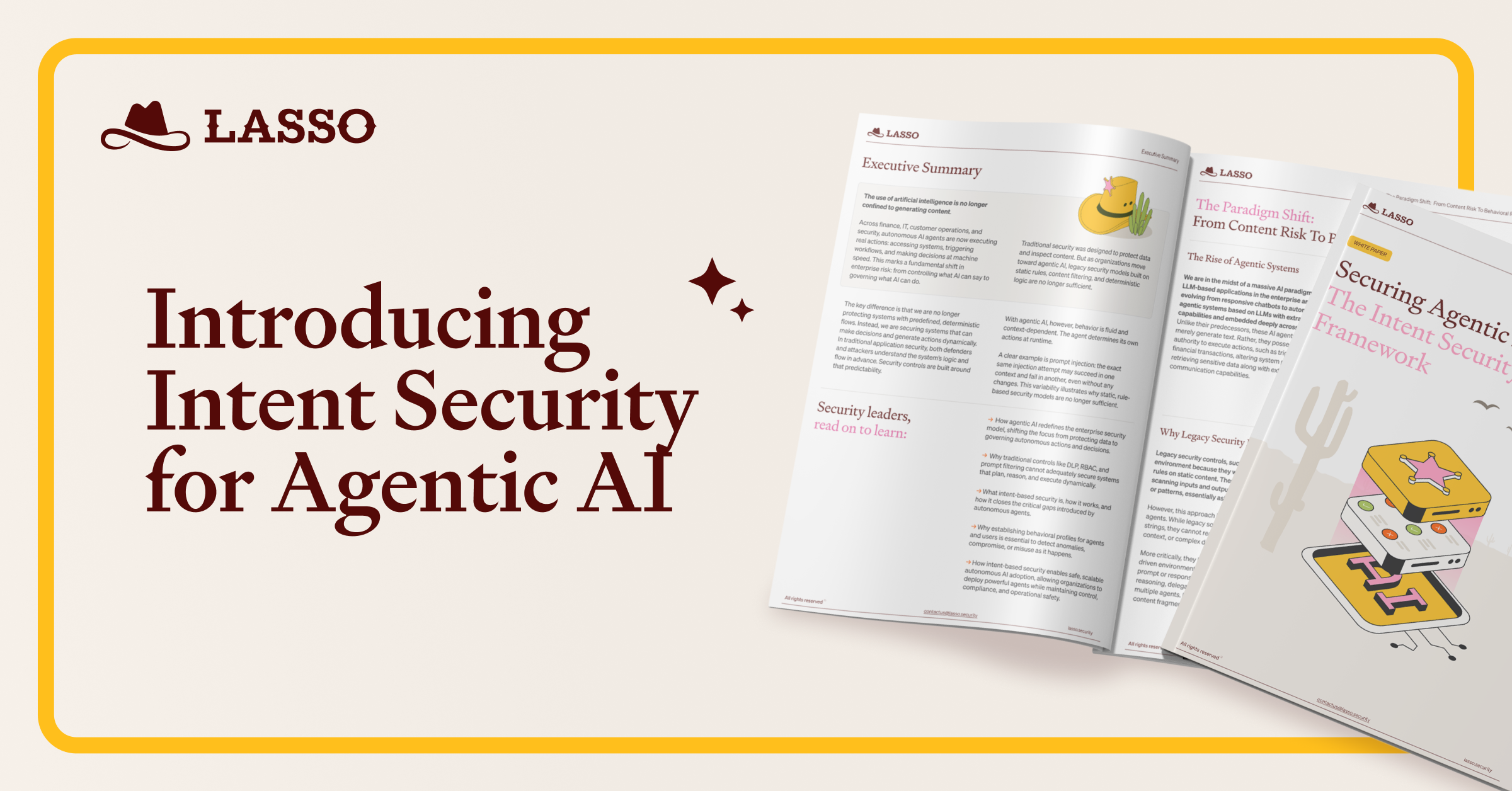
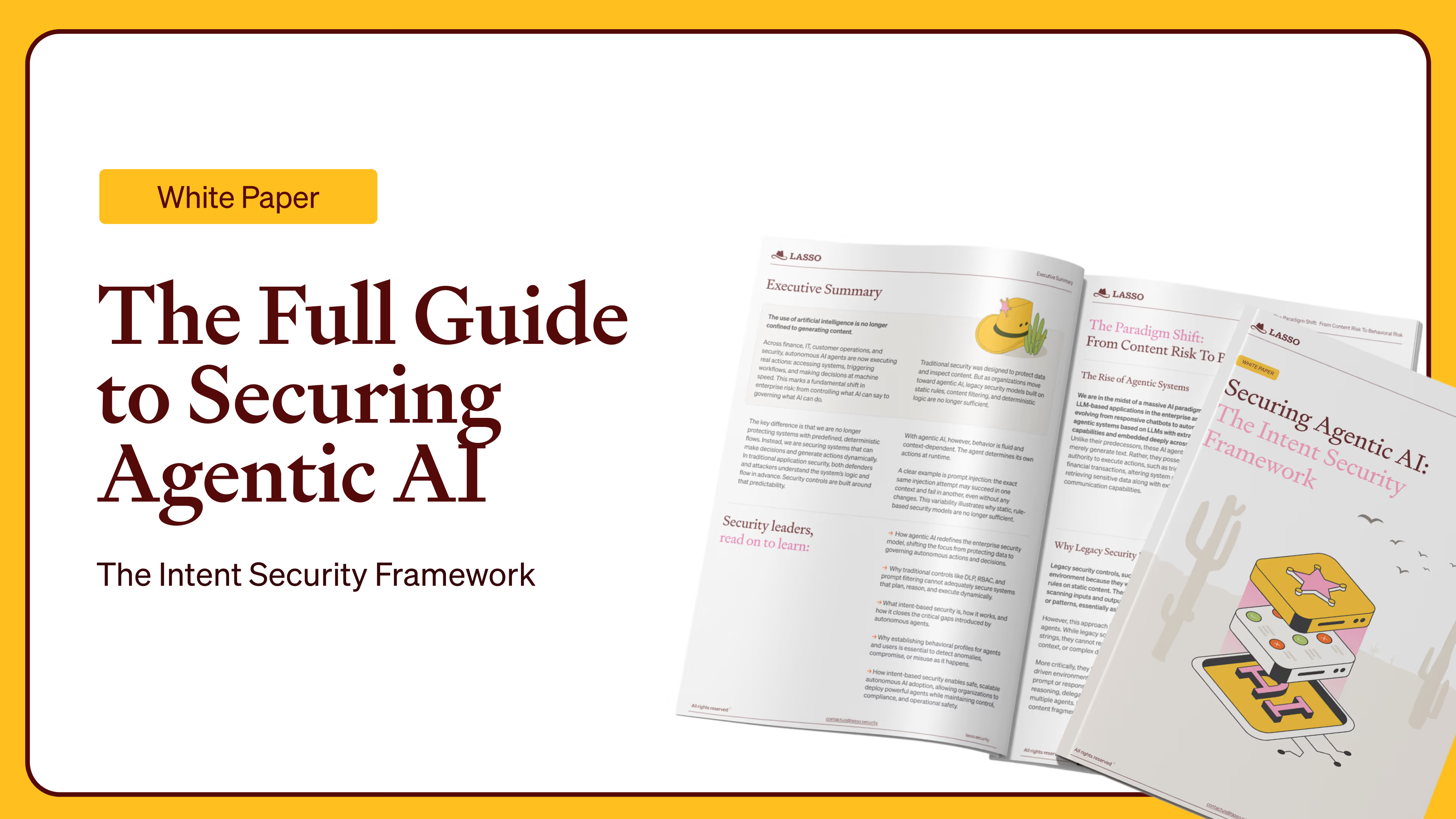
Securing Agentic AI: The Intent Security Framework