Introducing Intent Security: A Behavioral Baseline Framework for Agentic AI
.avif)
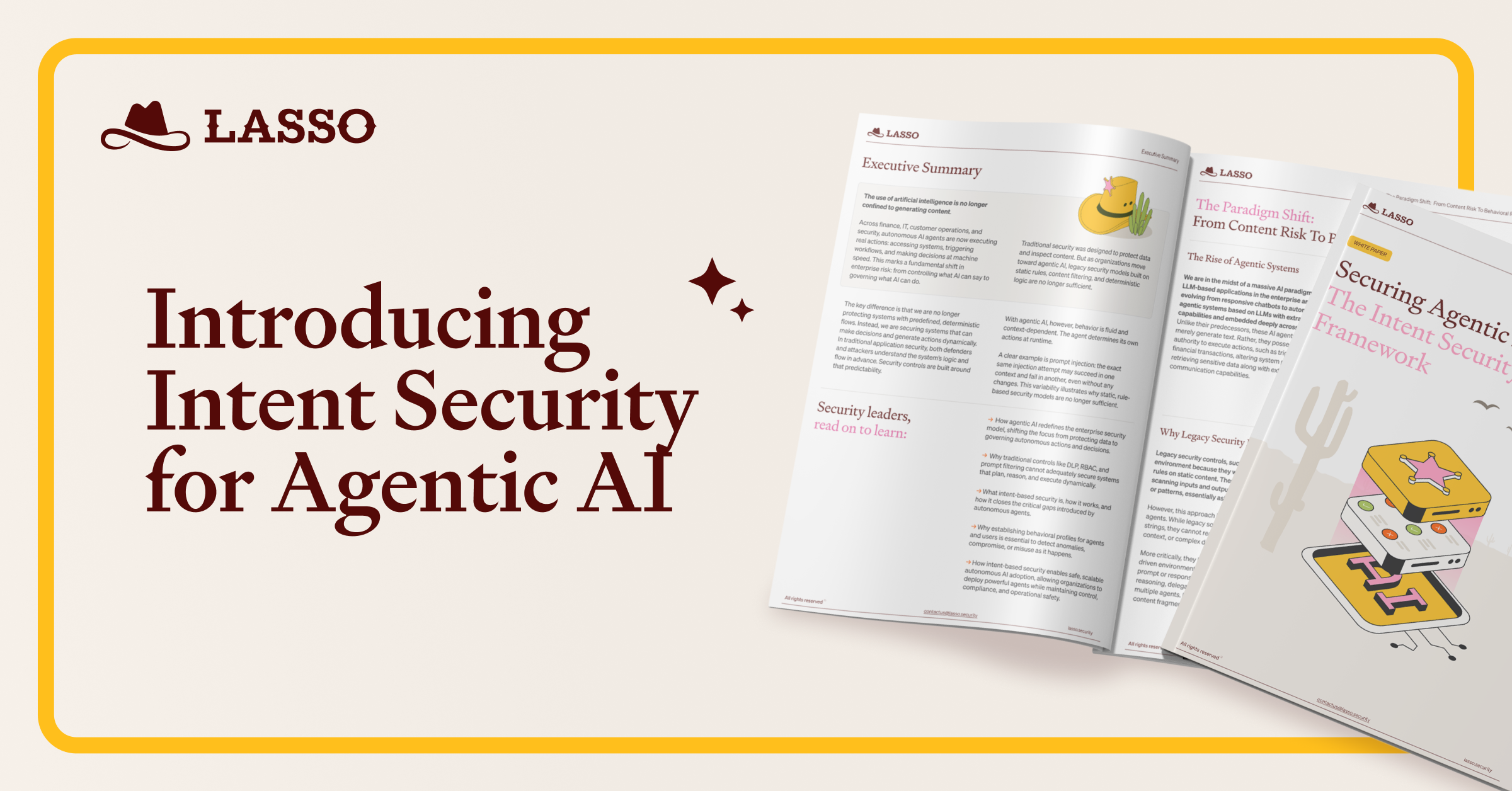
Agentic AI is forcing security teams to confront an uncomfortable truth: most existing AI controls were built for a world that no longer exists. The first wave of AI security matured around chatbots and copilots. Linear interactions, prompt and response. Outputs were the primary risk surface, and stateless inspection felt sufficient.
Agentic systems changed that model. They introduce memory, autonomy, tool use, and execution. Now, risk accumulates across sequences of decisions rather than single interactions.
This shift requires a new security primitive. Today, we are introducing Intent Deputy, Lasso’s behavioral baseline framework designed specifically for agentic AI environments.ֿ
Why Agentic AI Breaks Stateless Security
Traditional security tools inspect isolated events. They evaluate prompts and outputs independently, apply classification models, and enforce policy at a single point in time.
That approach worked fine for early GenAI usage patterns, but it doesn’t align with agentic systems.
Agents reason across multiple steps
An agent decomposes objectives into plans, executes intermediate actions, and adjusts based on prior results. Each step may pass policy validation individually, yet the cumulative plan can drift beyond the approved scope.
Instructions are split across turns
Intent is often shaped incrementally. Constraints, clarifications, and exceptions are introduced across interactions. Evaluating each turn independently obscures how earlier context reshapes later behavior.
Malicious intent is expressed indirectly
Attackers increasingly rely on indirection, steering intent and context rather than breaking anything. Guidance may be embedded within retrieved content, external inputs, or seemingly benign instructions. The agent follows the workflow, yet the trajectory shifts toward unintended outcomes.
Logic abuse unfolds gradually
Scope expansion, boundary testing, and incremental deviation often occur through small permissible steps. The violation emerges from accumulation rather than a single explicit breach.
In these environments, treating every interaction as an isolated event creates a false sense of compliance. Individual steps appear valid while the broader behavioral trajectory moves toward risk.
From Data Risk to Behavioral Risk
In early AI deployments, the dominant concern was data exposure through prompt leakage or improper retrieval. But in agentic systems, that risk profile expands. Agents operate in an action layer. They call APIs and interact with other agents.
Security teams are no longer securing only information flow, but also entire decision chains and execution paths.
Without visibility into how an agent’s behavior evolves over time, it becomes difficult to determine whether:
- Actions align with the agent’s assigned mission and scope
- A user’s request deviates from their historical behavioral profile
- External inputs are shaping behavior in unintended directions
- Intent has drifted before a harmful action is committed
This is the stateless security gap.
Behavioral Baselining as a Security Framework
Behavioral baselining addresses the stateless security gap by introducing both intent validation and continuity into security analysis.
The framework operates across two complementary layers.
1. Intent Alignment
Before historical patterns are evaluated, the system verifies that the agent’s action aligns with the user’s stated objective.
If a user requests a code push and the agent exports a PDF, that is an intent misalignment. The issue exists regardless of past behavior. Logical consistency between request, goal, and execution is the first control layer.
Intent alignment ensures that tool usage and actions remain coherent within the current interaction.
2. Behavioral Baselining
After immediate alignment is validated, behavior is evaluated over time.
The framework establishes a baseline for expected behavior across users, agents, and applications. It tracks how goals, actions, and decision paths evolve and compares current activity against historical patterns.
This requires:
- State awareness across sessions so actions are evaluated in context
- Historical modeling to define normal intent, scope, and authority
- Deviation detection to flag meaningful drift from expected behavior
- Real-time enforcement capable of intervening before operational impact
Together, intent alignment and behavioral baselining shift security from inspecting outputs to validating purpose, consistency, and trajectory.
Introducing Intent Deputy: Lasso’s Intent Security Framework for Agentic AI
Intent Deputy operationalizes this framework. It establishes a behavioral baseline for every AI user, agent, and application based on historical interaction patterns and contextual identity attributes. Each new request, action, and tool invocation is evaluated against that baseline to determine whether it remains aligned with defined purpose and scope.
Intent Deputy evaluates behavior across multiple dimensions, including goal consistency, scope adherence, authority alignment, and risk signals. It continuously analyzes the delta between assigned mission and observed behavior.
With Intent Deputy, security teams can reduce uncertainty enough to make defensible security decisions at machine speed.
Under the Hood: How Intent Deputy Works
Intent Deputy is powered by a stateful evaluation engine built to operate across the full agentic lifecycle.
Its operation follows four stages:
- Monitor interactions across users, agents, tools, and applications.
- Analyze the intent behind the user’s request and agent’s action, to ensure the two are aligned.
- Validate that the user and agent’s actions did not deviate from their behavioral baseline.
- Take action when risk thresholds are exceeded, through tiered enforcement. This can include real-time blocking of execution, masking of sensitive data in transit, or escalation through alerts for administrative review.
Speed and Accuracy Without Trade-Offs
Intent Deputy is engineered for high-speed, high-precision behavioral analysis in production agentic environments.
Real-Time Enforcement at Machine Speed
Risky actions can be blocked in under 50 milliseconds, with broader session-level behavioral analysis completing in under five seconds. Agents operate without perceptible latency, and workflows remain uninterrupted.
High-Fidelity Threat Detection
Detection accuracy across AI threat categories improves by up to 80 percent compared to stateless inspection models. This results in a false positive rate as low as 0.07 percent, reducing alert fatigue while increasing signal quality.
Performance at Scale
The multi-model evaluation engine operates up to 570 times faster than conventional sequential approaches, enabling continuous behavioral monitoring across users, agents, and tool chains without degrading AI-user experience.
Securing the Agentic Lifecycle
Agentic AI changes the security problem from isolated interaction risk to behavioral trajectory risk.
Securing this environment requires visibility into how intent forms, evolves, and executes over time. It requires controls that can validate alignment before operational impact occurs.
Intent Deputy represents Lasso’s step into this new category of stateful, intent-based security. As agentic systems become embedded across enterprise workflows, behavioral baselining becomes foundational for safe autonomy, explainable compliance, and controlled innovation at scale.
FAQs
How does Intent Security differ from traditional AI guardrails and data loss prevention tools?
What types of agentic AI risks cannot be addressed by stateless inspection models?
How does Intent Deputy maintain performance while analyzing behavior in real time?
What does implementing behavioral baselining look like in a complex, multi-agent enterprise environment?
Related Articles
.png)



Trusted Security for a World Run by AI