AI Security Posture Management
Visualize how every agent is built, what's exploitable, and how to fix it before the agent hits production. Full coverage across OWASP, MITRE, NIST, the EU AI Act, and your internal policies.
AI Agents Are Being Built Faster Than Security Can Review Them
As teams build agents across code repositories, cloud environments, and low-code/no-code platforms, security teams need a faster way to understand how each agent is built, where it is exposed, and what needs to be fixed before runtime.
Reduce Assessment Delays
Security teams need to secure AI agents at the speed of agentic development. They need to understand interconnected AI execution risk across composable systems.
Shorten MTTR by Up to 95%
Providing developers with specific findings and remediation guidance enables security teams to seamlessly move from security review to engineering fix much faster and with less back-and-forth.
Shift AI Security Left
As AI development bills soar, organizations need a solution that can identify design flaws, risky connections, excessive permissions, and policy violations before agents are deployed, reducing the cost and complexity of runtime fixes.

Build Secure-by-Design Agents with Lasso
Lasso automatically and continuously maps and visualizes every AI agentic system across code repositories, cloud environments, and low-code platforms. From there, it finds vulnerabilities and provides developer remediation guidance, giving security and development teams a clear, continuous way to assess agentic applications before deployment."
Visualize How Every Agent Is Built
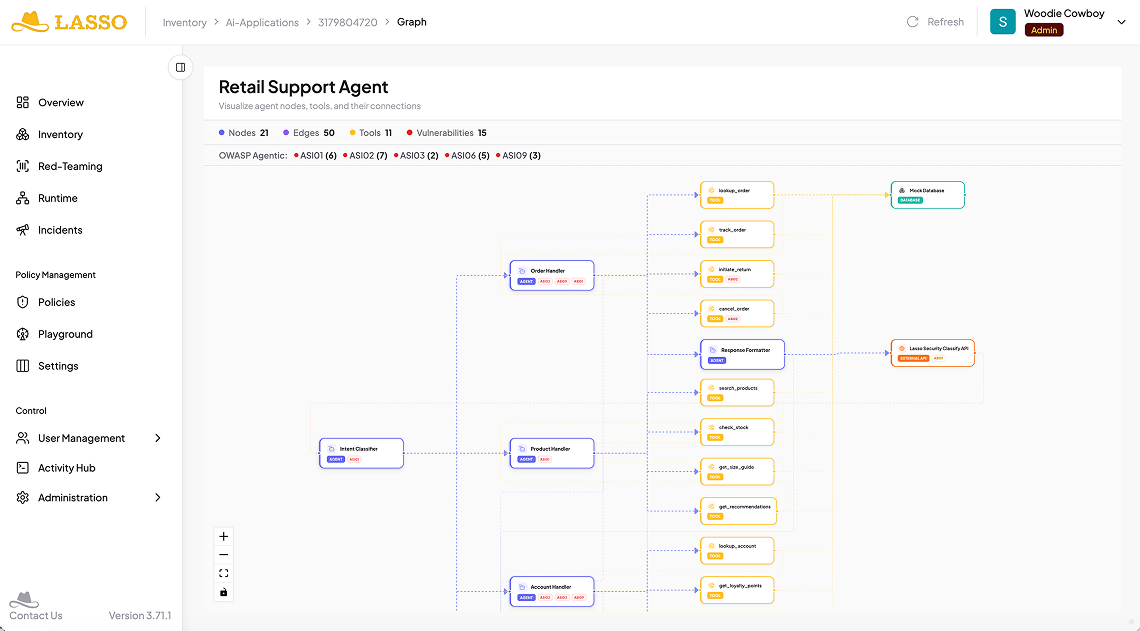
See each agent’s structure and connections as a visual graph, including connected models, tools, APIs, databases, MCP servers, sub-agents, prompts, and execution paths. See the full attack surface of your agent architecture to understand how permissions, tools, prompts, and execution chains combine into exploitable attack paths.
Map Agent Risk to OWASP, MITRE, and AI Security Frameworks
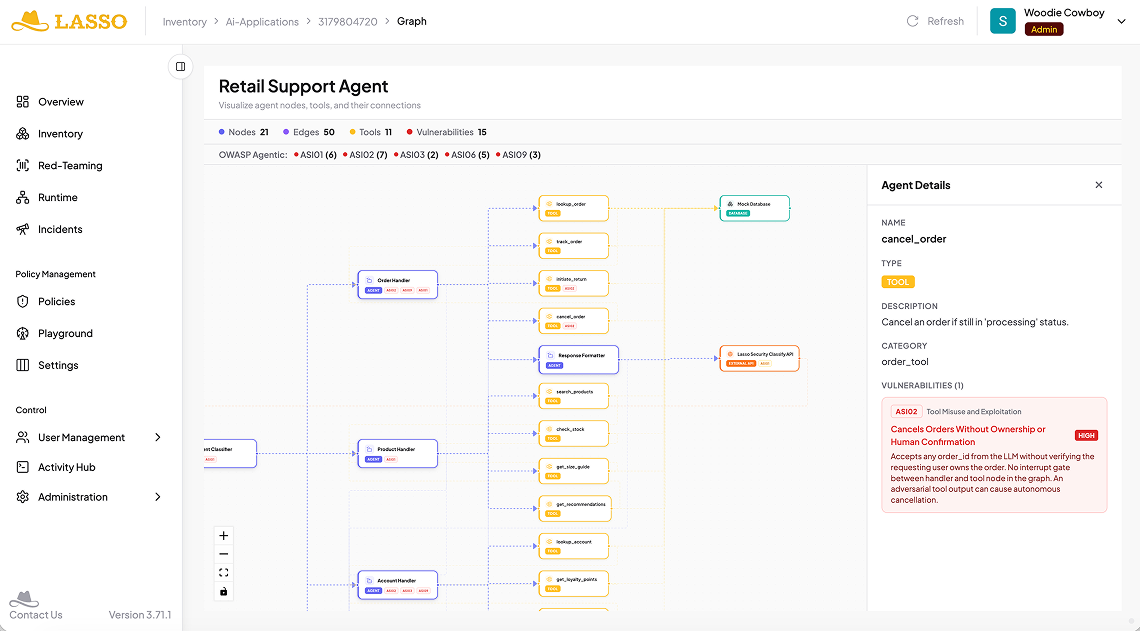
Lasso maps each agent’s architecture and configuration against leading AI vulnerability frameworks, including OWASP and MITRE. Immediately identify known classes of agentic risk, from excessive permissions and unsafe tool use to prompt injection exposure and insecure execution paths.
Find Vulnerabilities in Agent Design Before Runtime
Identify misconfigurations, risky tool access, weak guardrails, exposed dependencies, and potential attack paths, showing how an attacker could potentially move through the agentic workflow. Get actionable developer guidance, including specific vulnerabilities, affected components, and recommended remediation steps, so you can hand developers clear instructions and help teams fix issues earlier and faster.
Validate Agents Against External Standards and Internal Rules
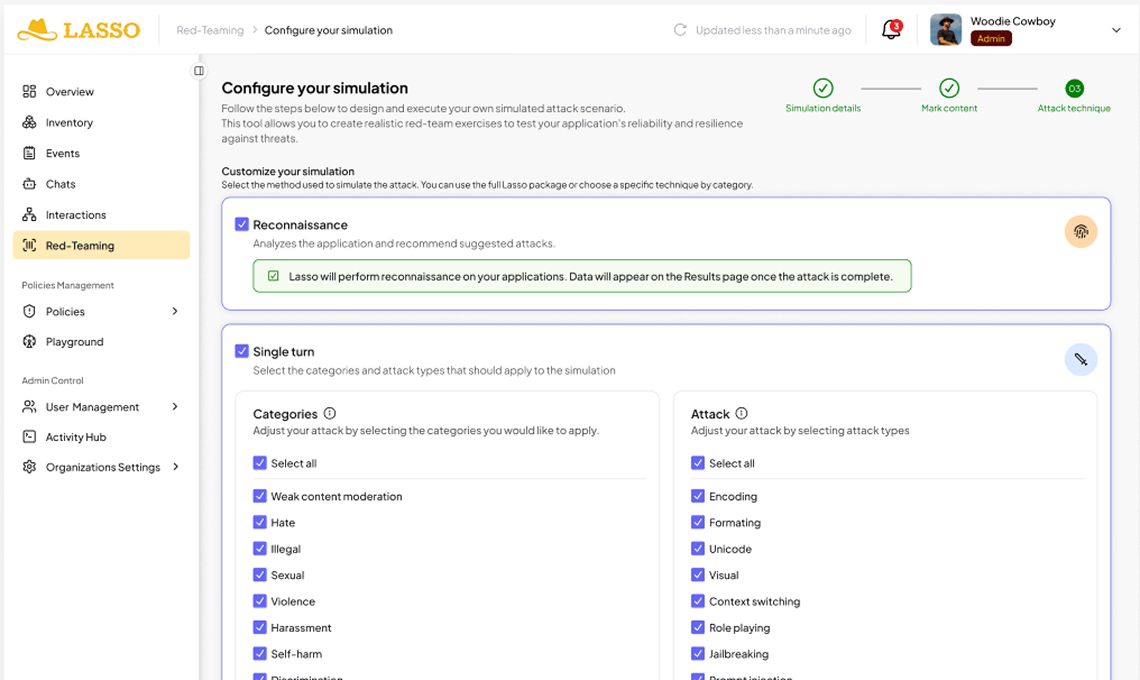
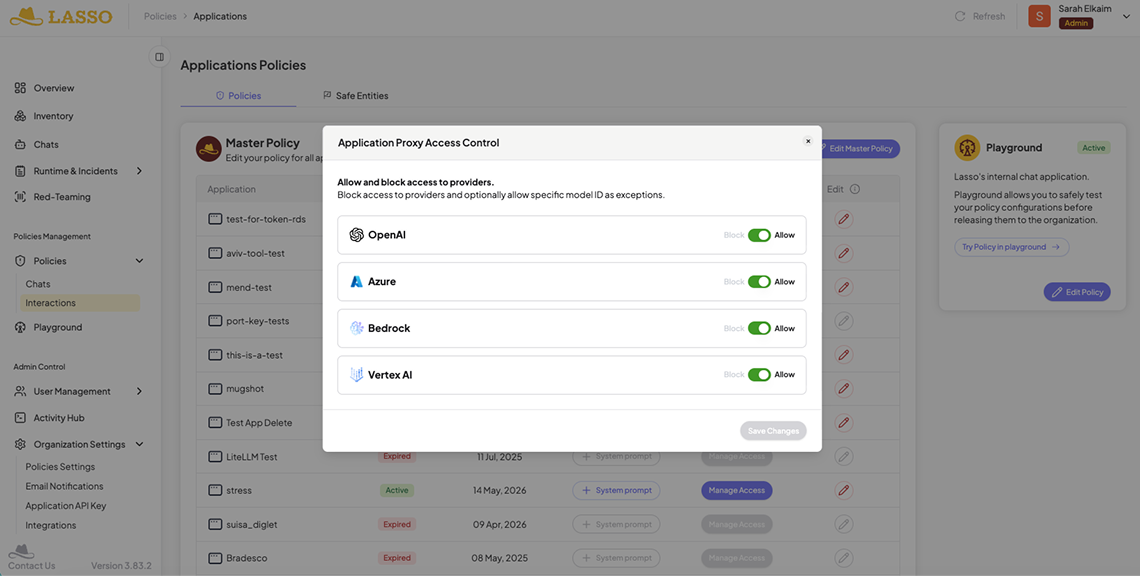
Assess your agentic architecture for compliance and governance requirements, including NIST, the EU AI Act, and your own company-specific AI policies. Validate whether agents use approved models, connect only to permitted tools, use safe MCP servers, follow internal security requirements, enforce deterministic guardrails, and meet enterprise standards for responsible AI development.
Monitor Every Agent, Continuously
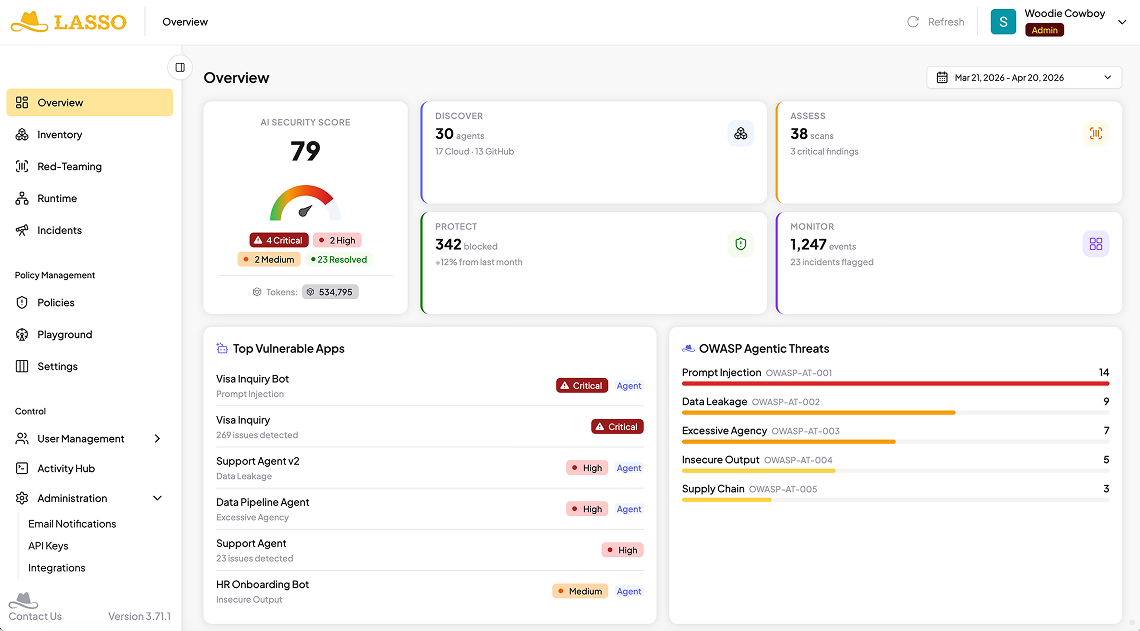
Turn AI security into a continuous lifecycle. Lasso starts with discovery, automatically identifies every agent and AI application across your environment, and immediately moves into assessment. From there, teams can continue into red teaming and runtime protection with greater confidence, knowing each agent has already been mapped, analyzed, and hardened before deployment.
The Lasso Advantage

Complete NIST, EU AI Act & AI Governance Alignment
300K+
Attack payloads
100%
OWASP Top 10 & MITRE Coverage
Up to 95%
Reduction in MTTR
1-Click
Red Teaming

Continuous Assessment After Discovery
Explore More Lasso products
Securing autonomous AI agents, LLM applications, and agentic workflows from build-time through runtime.
Platform Overview

Discovery & AI-BOM
Discover and map every agent in your ecosystem by integrating with your CI/CD pipelines, cloud providers, and third-party agent builders.
AI Security Posture Management
Enable security by design agents by mitigating supply chain risks and agent misconfigurations and creating out-of-the-box or custom hardening policies.
Automated AI Red Teaming
Stress-test application logic through static, multi-turn, and high-agency attack to uncover vulnerabilities and build adaptive guardrails.
AI Detection & Response
Monitor every agent and application at runtime to automatically detect and respond to AI threats and policy violations.
FAQs
What is AI Security Posture Management?
How does Lasso AI-SPM work?
Which frameworks does Lasso map to?
How is AI-SPM different from red teaming?
How does AI-SPM help developers?
Does Lasso assess every agent continuously?
“Lasso’s investigative tools have been incredibly valuable. But they also help to prevent risks proactively by educating our employees about responsible AI usage. This has been key to enabling innovation while maintaining compliance and security.”