Claude Code
Claude Code reads your codebase, executes shell commands, calls MCPs, and takes actions on your behalf. Lasso monitors the entire lifecycle, detecting indirect prompt injection, governing tool calls, and keeping agent behavior aligned with what the developer actually asked for.












%201.avif)

.avif)
Monitor your coding assistants and protect them at runtime.
Code Faster, with Confidence
Innovate freely with Claude Code without handing attackers an open door. Every tool output is scanned before Claude acts on it, every MCP connection is monitored, and every deviation from expected behavior is flagged in real time.
Protect Against Prompt Injection
Monitor all content Claude Code ingests and detect injected payloads or hidden instructions in files, web responses, and MCP outputs before they reach Claude's decision layer, with no changes to how your developers work.
Align Intent with Developer Goals
Coding agents are powerful because they act autonomously but that autonomy becomes a risk the moment an agent does more than what the developer intended. Ensure every action stays within the boundaries of what was actually asked for.
The Lasso AI Security Platform
Built from the ground up in the AI era, Lasso’s AI Security Platform empowers enterprises to unlock the full potential of LLMs and AI agents safely, responsibly, and confidently.
Best in Class AI Agents Security and Usage Control
Native Integration
Getting started takes minutes. Lasso connects directly to Claude Code's lifecycle hooks via the enterprise management platform so developers keep working exactly as they do today.
Compliance-Ready Audit Trail
Every interaction is monitored and saved, giving security teams a complete record of what every coding agent did and when.
Vendor Agnostic
Secure any coding assistant your developers use, including Claude Code, Cursor, Codex, and OpenCode, and more.
No Developer Friction
Operates at the infrastructure layer, with minimal added latency and no change to how Claude Code runs. Security teams get full visibility without disrupting the developer workflow.
Core Components of Agentic AI Security
Hook Into Every Stage
Claude Code's hooks run at defined points in the agent lifecycle. Lasso deploys configuration through Claude Code's native rules, so there is no agent to install and no code to change. Security attaches where the agent already operates.
Monitor Every Interaction
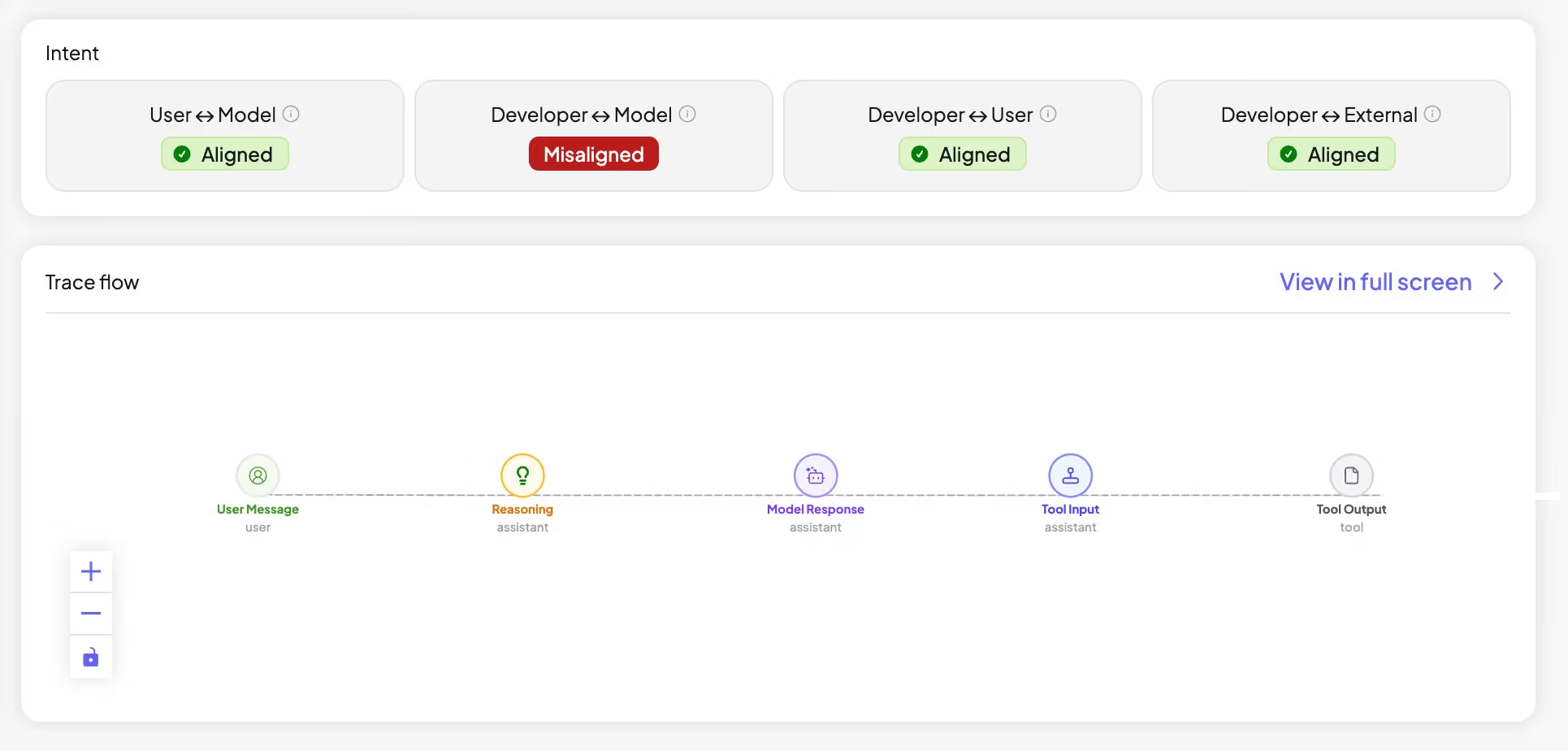
Lasso scans content and identifies injected instructions embedded in files, web responses, or MCP outputs, which are flagged before they reach Claude's decision layer.
Govern Every Tool Call
Lasso inspects every tool call before it is executed. Security teams define what tools are permissible within a given scope, and anything outside that scope is flagged or blocked.
Enforce Intent Security at Runtime
Lasso's Intent Security Engine continuously measures whether agent actions stay aligned with the developer's original instruction. When an agent acts outside the scope of what was asked, that deviation is caught and flagged before it lands.
How Claude Code Is Used Across Your Org?
Claude Code is spreading across engineering orgs faster than security teams can track it. Lasso gives security teams a consolidated view of which MCPs are connected, what tools are being called, and where usage patterns are drifting, with a full exportable audit trail for compliance.
FAQs
What is the security risk of using Claude Code with --dangerously-skip-permissions?
What is indirect prompt injection in Claude Code?
What are Claude Code hooks and how does Lasso use them?
Is Lasso compatible with other AI coding assistants besides Claude Code?
How does Lasso deploy across an enterprise without touching individual developer machines?
What does intent security mean in the context of coding agents?
How does Lasso handle tool governance for MCP-connected agents?