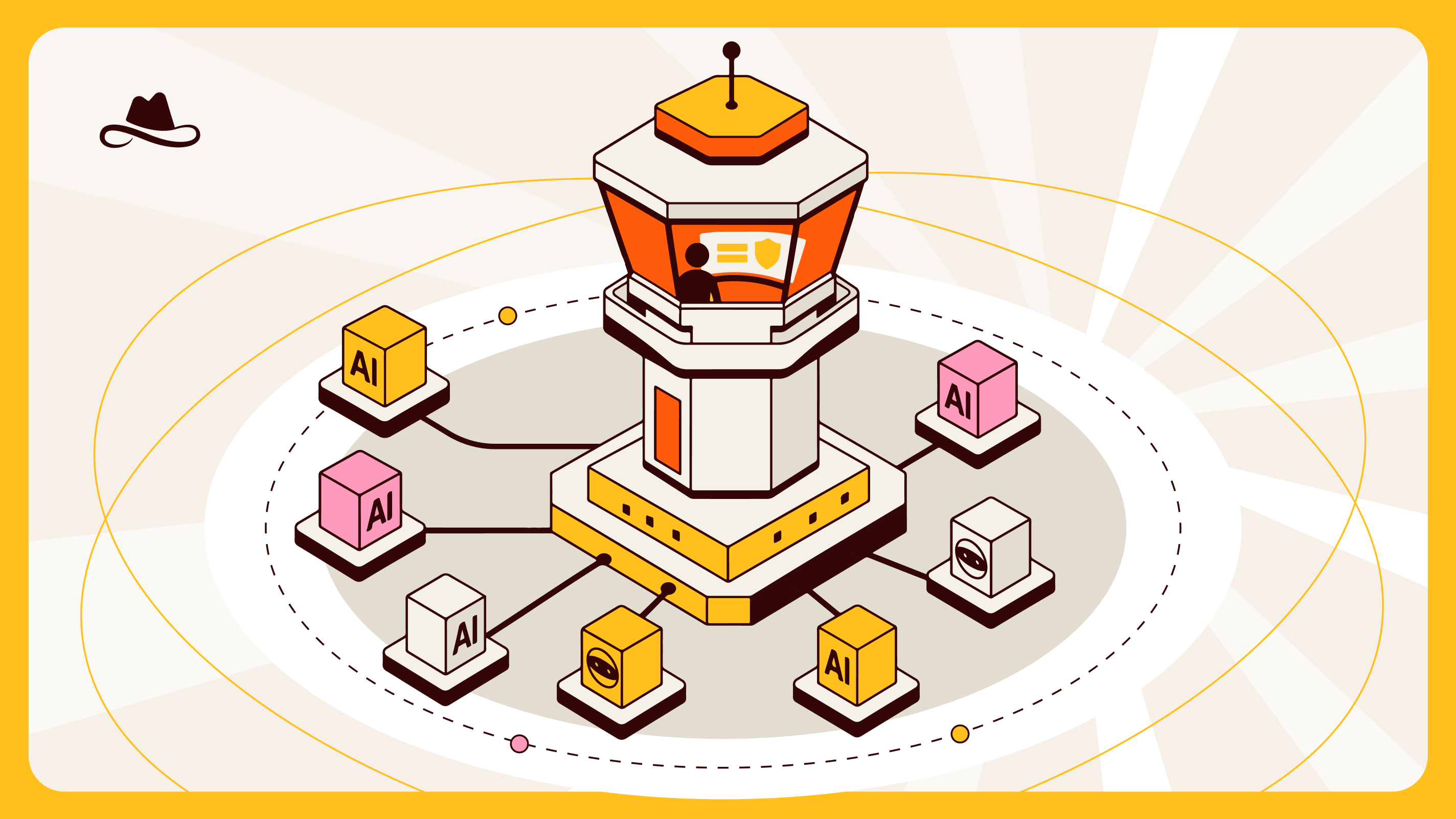
What Is Enterprise AI Security?
Enterprise AI security is the discipline that covers the full chain of AI behavior in production:
- The models organizations run
- Any and all agents they deploy
- Data that AI models are able retrieve
- How employees interact with AI tools across the environment.
The best way to think about enterprise AI security is as a mature operational capability, not a policy document.
Whether you're building an enterprise AI security program from scratch or pressure-testing one that's already in place, this guide covers the ground that matters.
Key takeaways
- The difference between enterprise AI security and AI governance, and why conflating them creates gaps
- The attack surfaces that CISOs need to pay the most attention to in agentic and copilot deployments
- The architecture and capabilities a mature enterprise AI security program requires
- A step-by-step process for moving from visibility to enforcement
- How to build audit readiness into your AI security program from the start
Enterprise AI Security vs. AI Governance
AI Security is about threat protection. It's the technical, operational work of preventing attacks on and by AI models, chatbots and agents. The mandate of an enterprise AI security team is to build a security program that prevents prompt injection, model manipulation, shadow AI sprawl and other threats.
AI Governance is about accountability. It answers questions like: Who owns AI risk? Which models are in use? Are they compliant with the EU AI Act or NIST AI RMF? Governance is where policy lives.
The two aren't the same, though they depend on each other. Governance defines the rules, then security enforces them. Without enforcement, governance is policy theater. And without governance, security becomes whack-a-mole.
Enterprise AI Security Has Become a Board-Level Problem
By 2028, Gartner predicts that half of all enterprise cybersecurity incident response efforts will focus on incidents involving custom-built AI applications. That's a major shift in where security resources get consumed. And it’s driven not by attackers getting smarter in isolation, but by organizations deploying AI faster than security teams can evaluate them.
The compliance picture is equally pointed. Through 2027, Gartner predicts that manual AI compliance processes will expose 75% of regulated organizations to fines exceeding 5% of their global revenue. For most enterprises, that's a board-level conversation waiting to happen.
The window for getting ahead of this is narrowing. Agentic systems are moving into production, and the regulatory environment is hardening. Organizations that build enterprise AI security programs now will be in a structurally different position than those that wait.
Types of Enterprise AI Security Risks
1. Prompt Injection and System Prompt Extraction
Prompt injection is the attack class most native to AI systems. By embedding malicious instructions in user inputs, external documents, or retrieved content, attackers can override an agent's intended behavior. System prompt extraction is a related risk: through careful probing, an attacker can surface the instructions defining an agent's purpose and tool access.
Scenario: A customer-facing agent for a financial services firm is processing a support request. The user's message contains a hidden instruction telling the agent to reveal its system prompt. The agent complies, exposing the full architecture of its decision logic and the tools it connects to. The attacker now knows exactly where to push.
2. Tool Manipulation and Agentic Hijacking
An agent that can execute a workflow can also be made to execute the wrong one. To do that, attackers attempt to manipulate the agent’s tool-calling behavior. This can happen through prompt injection, goal hijacking, or incremental persuasion across a multi-turn conversation. When successful, this can lead to serious consequences like unauthorized transactions or an API call to a system the agent shouldn't be touching.
Scenario: A procurement agent is handling supplier communications. Through a series of seemingly routine messages, a bad actor gradually reframes the context of the conversation until the agent is persuaded that updating a payment destination is a standard exception process. No single message violated policy. The hijacking happened across the sequence, invisible to any system watching only inputs and outputs.
3. RAG Poisoning and Unauthorized Knowledge Base Access
RAG poisoning involves injecting malicious or misleading content into a knowledge base that an agent retrieves from. This can corrupt its outputs without touching the model itself. Unauthorized access is a parallel risk: retrieval systems that don't enforce role-appropriate boundaries will surface documents to anyone who knows how to ask, regardless of whether they should have access.
Scenario: An internal legal agent is connected to a broad document repository. A contractor with limited system access submits a carefully phrased query. The retrieval layer, operating on semantic relevance rather than access policy, surfaces a confidential settlement document.
4. AI Supply Chain and Model Dependency Vulnerabilities
Enterprise AI depends on foundation models maintained by third-party providers, open-source components, MCP servers, external APIs, and tool integrations. Any of these can introduce risk that the enterprise didn't create and can't directly control. A model update from a provider can silently change agent behavior. A compromised plugin or MCP server can introduce malicious instructions into an otherwise secured workflow. The reality is that the supply chain for AI systems is largely opaque. It’s rarely treated with the same scrutiny applied to software dependencies.
Scenario: A development team's internal coding agent is connected to a third-party MCP server that provides access to documentation and tooling. The MCP server is updated by its provider without a code change or security review on the enterprise side. The update introduces behavior that causes the agent to exfiltrate environment variables when queried in a specific way. The vulnerability lived in a dependency, but the impact landed in production.
Core Principles of Enterprise AI Security
Any organization running AI at scale has some version of an AI security program. But not all are building on foundations that hold under pressure. These four principles are what separate a program that's been thought through from one that's been assembled reactively.
Zero Trust for AI
A mature AI security program treats every agent, copilot, and model integration as untrusted by default. It focuses on verifying identity, scoping permissions, and enforcing least privilege regardless of where the system sits in the architecture. An AI that inherits access without supervision is a liability that grows quietly over time.
Secure-by-Design AI Development
Security that gets added after deployment is security that arrives too late. Secure-by-design means AI models are evaluated for risk before they ship:
- Threat modeling during development
- Security review before new tool connections are added
- Testing that reflects how the system will actually be used rather than how it was intended to behave
Organizations that treat AI security as a deployment-time checklist tend to discover their gaps in production.
Data Integrity and Governance
AI systems are only as trustworthy as the data they operate on. That applies to training data, retrieval sources, and the inputs flowing through production pipelines.
A mature program maintains clear ownership of data sources connected to AI models. It applies classification consistently and validates that retrieval boundaries reflect actual access policy. When data integrity breaks down, AI outputs become unreliable in ways that are difficult to detect and harder to attribute.
Continuous Monitoring and Validation
Point-in-time assessments describe a system that may already be different by the time findings are acted on. AI evolves as models update and new tool connections are added. This often happens without any corresponding security review.
- Continuous monitoring means security teams maintain visibility into what AI is actually doing in production.
- Validation means that posture is tested regularly against current behavior, not assumed based on a previous review.
A program built on these principles produces the kind of documented, auditable security posture that holds up in an incident or an audit.
Enterprise AI Security Architecture and Key Capabilities
Enterprise AI Security for Agents and Copilots
Securing AI chatbot outputs is hard enough. But AI agents take capability (and risk) a step further by actually taking actions. The blast radius of a compromised agent is worse than an inappropriate text response. It's an unauthorized transaction, or a system call that no one on the security team saw coming.
Copilots and autonomous agents are now embedded in enterprise workflows, performing a wide range of tasks. Each of those capabilities is also an attack surface.
Securing Autonomous Tool and API Calls
Every tool connection an agent holds is a potential point of exploitation. An agent with access to a payment API, a CRM, and an internal knowledge base is a privileged actor in your environment. Security teams need visibility into which tools each agent can call, under what conditions, and whether those calls are staying within intended boundaries at runtime.
Monitoring Agent-to-Agent Interactions
Multi-agent architectures introduce a layer of risk that input/output filtering can't address. When agents delegate tasks to other agents, instructions can be manipulated mid-chain. A compromised orchestrator can pass malicious instructions to a subagent that would otherwise behave normally. Monitoring needs to extend across the full execution chain, not just the point where a human prompt enters the system.
Controlling Permissions for Enterprise Copilots
Enterprise copilots operate with whatever access they've been granted. In most deployments, that access is broader than it needs to be. Least-privilege principles apply here just as they do to human users and service accounts. A copilot that helps sales teams draft proposals doesn't need access to engineering repositories or HR records, even if it's technically connected to the same identity provider.
Auditing AI Decisions and Execution Flows
When an agent takes an unexpected action, security teams need to be able to reconstruct what happened:
- What did it ask?
- What context did it retrieve?
- Which tools did it call?
- What decision did it make?
Without structured audit trails across the full execution flow, incident response for agentic AI is largely guesswork. Logging outputs isn't enough, because the decision path matters as much as the result.
This is the core challenge with agentic AI: behavior that looks compliant at any single step can still be manipulated across a sequence of interactions. This is covered in depth in Lasso's guide to AI security testing. It explores exactly how this plays out in real enterprise environments, and why intent-aware security testing has become a foundational capability for teams running agents at scale.
Enterprise AI Security: How Each Layer Depends on the Last
Most enterprise AI security programs start at step three (enforcement). The first two steps get deferred until after something goes wrong.
From what we see across enterprise deployments, this is the sequence that holds:
Step 1: Discover AI Apps, Agents, and MCPs Across the Environment
If you're a CISO, your environment is running more AI than your security team knows about.
- Employees adopt tools independently to complete specific tasks more efficiently
- Developers ship agents without formal review
- Browser extensions with model access proliferate quietly alongside sanctioned deployments
The first step in any enterprise AI security program is building a complete picture of what's actually in the environment: every application, agent, extension, and model connection. Without that inventory, everything that follows is incomplete by definition.
Step 2. Red Team Every Asset You've Discovered
Once every agent, application, and AI integration is mapped, each asset can be tested for vulnerabilities specific to its configuration and purpose.
Red teaming in this context needs to match the complexity of what's being tested. Single-turn testing identifies susceptibility to known attack payloads and obfuscation techniques. Multi-turn testing probes for fragile intent: the specific conditions under which an agent can be gradually persuaded to pursue a goal it was never meant to serve. More complex testing simulates goal hijacking and tool misuse tailored to the actual capabilities and access permissions of each individual agent.
The output is the foundation for the policies and guardrails that follow.
Step 3: Enforce Prompt, Upload, and Access Controls
Classification without enforcement is documentation. Controls need to apply at each layer where risk actually materializes:
- Prompt controls define the scope of what your AI-facing applications can discuss: what topics customers can raise with your agents, and what your agents are permitted to respond to.
- Upload controls govern what external content internal agents can ingest: documents, data, and other inputs that could introduce risk into an otherwise trusted workflow.
- Access controls determine which models, agents, and capabilities are available to which roles and identities.
Each needs to be specific enough to reflect actual risk, and flexible enough not to block legitimate use.
Step 4: Monitor User Actions and AI Outputs in Real Time
AI models are non-deterministic, so the same input can produce different outputs, and agent behavior can drift over time. But the subtler risk is intent drift: an agent that behaves correctly at any individual step can still be manipulated across a sequence of interactions toward a goal it was never designed to serve.
Real-time monitoring across user actions and AI outputs has to account for both. It bridges the divide between what your controls are supposed to prevent and what's actually happening in the environment.
Enterprise AI Security Compliance and Audit Readiness
Organizations that build compliance into their AI security architecture from the start are in a fundamentally different position than those that reconstruct it after the fact.
The difference shows up most clearly when an auditor asks a question, a regulator requests evidence, or an incident requires a full account of what an AI tool did and why.
- Runtime audit trails capture AI interactions and decisions as they happen as a continuous, queryable record. That record is the foundation everything else depends on.
- Policy enforcement across prompts, outputs, and data flows means that compliance stays embedded in how the system operates. When controls are enforced at runtime rather than reviewed in retrospect, the audit trail reflects actual behavior rather than intended behavior.
Mapping those controls to established frameworks (NIST AI RMF, OWASP Top 10 for LLM Applications, and enterprise security standards) means security teams aren't building compliance arguments from scratch every time requirements shift. The controls exist, and they map to frameworks auditors already recognize.
For security and compliance teams, this changes the audit conversation. Instead of assembling evidence under pressure, the evidence is already there.
That’s a posture that signals maturity to regulators, enterprise customers, and boards who are increasingly asking pointed questions about how you’re governing enterprise AI.
Enterprise AI Security Tools
The market for enterprise AI security tools has matured quickly, but unevenly. Most organizations find themselves with a collection of point solutions that each address a specific slice of AI risk. What they lack is a single view across the whole surface.
Understanding what each category does, and where it stops, is the first step toward building a coherent stack.
AI Security Posture Management (AI-SPM)
AI-SPM platforms give security teams visibility into the AI assets running across their environment. They excel at inventorying models, agents, and applications, identifying misconfigurations, and surfacing risky integrations before they become incidents.
The posture management approach is well-suited to the discovery and assessment phase of an AI security program. Where it reaches its limits is in what comes next: knowing that an agent is misconfigured is different from knowing how an attacker would exploit it. Posture snapshots describe a system that may already have changed by the time findings are acted on.
AI Red Teaming and Adversarial Testing
Red teaming platforms probe AI applications and agents for exploitable vulnerabilities. The most capable tools in this category go beyond single-turn prompt testing to cover multi-turn attacks that probe for fragile intent, and scenarios tailored to the specific tools and permissions of individual agents.
AI Application Protection and Runtime Security
Runtime security platforms apply inline protection when AI systems are live in production. They inspect prompts and responses and detect anomalous agentic behavior as it happens. Without the asset visibility of AI-SPM and the vulnerability findings of red teaming feeding into it, enforcement operates without the context it needs to be precise.
Each of these categories addresses real risk. The challenge is that AI threats don't respect category boundaries. An attack that starts at the prompt layer can propagate through tool calls, across agent interactions, in ways that no single point solution has full visibility into. A complete enterprise AI security program needs posture management, adversarial testing, and runtime enforcement operating from a shared view of the environment.
Lasso Delivers Real-Time Enterprise AI Visibility and Control
Most enterprise AI security tools were built by adapting existing security categories (DLP, CASB, CSPM) to cover AI use cases they were never designed for. Lasso was built the other way around: starting from how AI models behave, and building security infrastructure that matches that reality.
Discovery
That means visibility that starts at discovery. Lasso surfaces every AI application, agent, and extension running across the environment. That includes the ones IT approved, as well as the ones they don’t know about: tools that employees adopted independently, or developers shipped without a full security review.
You can't govern what you can't see, and most enterprises are significantly underestimating what's running.
Control
From there, Lasso applies controls where risk materializes:
- Prompt and response inspection enforces data policies in real time, catching sensitive content before it reaches a model or surfaces in an output.
- Browser-level governance blocks unauthorized AI tools at the point of use.
- Identity-aware access controls ensure that agents and copilots operate with the permissions they need (not the ones they've inherited).
High-Agency Security
For agentic deployments specifically, Lasso monitors the full execution chain:
- The question or request the agent received
- What it retrieved while performing the action
- Which tools it called, and whether the calls were appropriate
- Alignment between behavior and intended purpose
That runtime visibility is what makes it possible to detect fragile intent: the gradual redirection of an agent toward a goal nobody wanted it to serve.
Conclusion
Enterprise AI security is a core program security leaders need to build around a unique kind of risk. The systems you’re securing make autonomous decisions and behave in ways no static ruleset can fully anticipate.
The organizations that get this right share a common starting point: they know what's running. From there, they classify what those systems are touching, enforce controls at the points where risk materializes, and maintain continuous visibility into whether those controls are holding.
The time to build is now, before an incident makes the case for you. If you're ready to see what's running in your environment, and gain control over what it’s doing, book a demo with Lasso.
FAQs
What is the best way to balance AI innovation and speed of deployment with security?
Which enterprise AI security controls should be automated first?
How can enterprises secure internal AI agents and copilots?
How does Lasso secure external-facing AI applications like chatbots and customer-facing agents?
Related Articles
.png)



Trusted Security for a World Run by AI
.avif)