
What Is AI Security in the Agentic Era?
AI security used to mean protecting the data you fed into a model and governing what came out. That problem hasn't gone away, but it's no longer the hard part. In 2026, the hard part is securing systems that don't just respond, but act. Agents that browse, write, execute, call APIs, spin up other agents, and make sequential decisions with real-world consequences.
That's what makes AI security a distinct discipline today, not a subcategory of application security or data protection. When an agent can be manipulated mid-task through a poisoned tool response, or redirected by an injected instruction buried in a retrieved document, the threat model looks nothing like anything traditional security frameworks can address. Organizations deploying agentic AI in 2026 are managing autonomous behavior at scale, often without visibility into what their agents are actually doing.
Key takeaways
- Agentic AI has fundamentally changed the threat model. Prompt injection, context poisoning, tool misuse, and agent-to-agent exploitation are risks that traditional security frameworks weren't built to handle
- Visibility is the baseline: organizations can't govern, assess, or protect AI systems they don't know are running, and most are significantly underestimating what's deployed,
- Runtime enforcement matters more than configuration: least privilege, input validation, and intent-based controls must be active and continuous, not set once at deployment.
- AI security is a loop, not a checklist: discovery, posture management, red teaming, and runtime protection must operate together and adapt continuously as models, tools, and agents evolve.
Types of AI Security Risks
Top AI Security Best Practices for Organizations in 2026
AI Security Best Practices Across the Full Lifecycle
AI security needs to function as a loop. The scenario below shows how each stage connects in practice, following a single incident across a financial services firm's agentic environment.
A compliance agent deployed to monitor regulatory filings begins behaving anomalously. Here's what the lifecycle looks like when security is working.
- Discover and inventory every AI agent and application
In this case, discovery surfaces not just the compliance agent, but three downstream agents it spawns during complex filing reviews. None of these were formally registered with the security team.
- Assess risk and manage security posture continuously
With a complete inventory in place, each agent's risk profile is assessed. The compliance agent holds read access to sensitive regulatory data and write access to external filing systems. This permission combination registers as high-risk and triggers a posture review.
- Run automated red teaming before threats do
Adversarial testing reveals the compliance agent is vulnerable to prompt injection via a third-party data feed it queries during filing reviews. Manual testing would have been unlikely to find this within a standard engagement scope.
- Enforce runtime protection across every environment
Guardrails are updated based on red teaming findings, restricting how the agent processes external feed inputs. When a malicious instruction is later embedded in a feed response, inline enforcement catches and blocks it before the agent acts. -
- Detect and respond to AI threats in real time
Weeks later, an attempted attack via a different vector triggers a behavioral anomaly. Because every tool call and data retrieval is monitored continuously, the deviation is detected within seconds and the agent is isolated before any data leaves the environment.
Core AI Security Best Practices
The principles below apply across every AI deployment, agentic or otherwise. Each one addresses a failure mode that organizations consistently underestimate until it becomes an incident.
- Maintain visibility across all AI assets: Shadow AI and developer-deployed tools routinely operate outside security team awareness. Continuous discovery is the baseline.
- Apply least privilege to models, APIs, and tools: Agents should operate with the minimum access required to complete their defined task. Broad permissions provisioned for convenience become the blast radius of a compromise.
- Validate inputs and outputs continuously: Malicious content doesn't always arrive at the first prompt. Inputs from tool responses, retrieved documents, and external APIs all require validation at every stage of execution.
- Apply intent-based controls across the execution trace: Rule-based controls catch known violations. Intent-based controls monitor whether an agent's behavior at each step reflects its actual purpose.
- Integrate security into development pipelines: Security reviews that happen after deployment are too late for agentic systems that move fast. Embedding controls at the build stage ensures agents are assessed before they reach production, not after something goes wrong.
AI Security Best Practices for Agentic Applications
AI Security Best Practices for the AI Supply Chain
The models and integrations organizations depend on are themselves an attack surface. A foundational model update or a third-party tool with undisclosed data handling practices can silently invalidate a security posture that was sound at deployment.
- Assess foundational model and third-party risk: Every model dependency carries inherited risk that can shift without notice. Assess how behavioral changes in upstream models could affect downstream agents before deploying or updating.
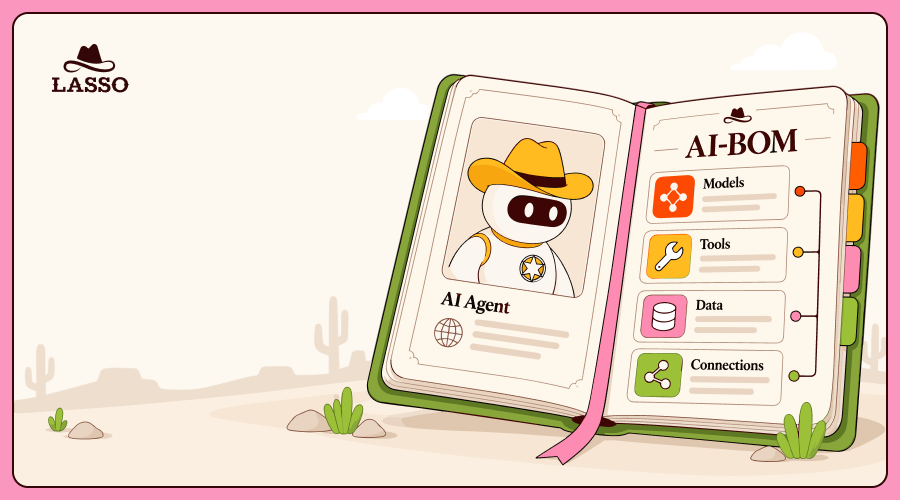
- Maintain an AI Bill of Materials: A continuously updated inventory of every model, tool, integration, and dependency across the AI stack is the baseline for supply chain security. Without it, organizations can't assess exposure when a vulnerability surfaces in a third-party component.
- Monitor for behavioral drift from agent baseline: Model updates and integration changes can alter agent behavior in ways that aren't announced. Establish a behavioral baseline for every production agent and monitor continuously for deviations in output patterns, refusal behavior, or tool usage.
- Validate third-party integrations before and after deployment: Security review shouldn't stop at onboarding. Third-party tools, MCP servers, and external APIs need continuous monitoring in production because what a tool does at launch and what it does six months later aren't always the same.
Automated Red Teaming as a Core AI Security Best Practice
Agentic AI systems don't fail the way traditional software fails. They drift, get redirected, and compound decisions across tool chains in ways that only surface under adversarial conditions. Red teaming is the only reliable way to find those failure modes before attackers do.
- Traditional red teaming falls short for AI agents, because agentic environments change faster than manual test cycles can track. Human testers on their own can't anticipate attack paths that multi-step agent workflows generate dynamically.
- High-agency red teaming covers the full kill chain: Rather than testing prompts in isolation, high-agency red teaming simulates adversaries moving across the full chain to expose compounding vulnerabilities that point-in-time assessments miss.
- Static, dynamic, and high-agency attack modes: Lasso’s automated AI red teaming operates across three components: static testing probes for jailbreaks and refusal bypasses; dynamic testing simulates behavior across live inputs and tool states; high-agency testing deploys offensive adversarial agents that adapt autonomously.
- Using red teaming results to auto-update policies: Findings feed directly back into policy updates, automatically tightening guardrails based on what testing reveals. The loop between offensive testing and defensive policy makes the system harder to exploit with every iteration.
AI Security Governance and Compliance Best Practices
AI governance without enforcement is policy theater. As regulatory scrutiny around AI intensifies and agentic deployments scale, security teams need a compliance posture that's continuous and auditable.
How Common AI Security Challenges Are Evolving
Securing agentic AI isn't an extension of existing security practice, but a different problem with its own dimensions. The challenges organizations face in 2026 revolve around securing systems that reason, act, and compound decisions in ways no prior security framework was designed to handle.
Visibility into agent behavior is fundamentally limited
Traditional security assumes you can observe what a system is doing. Agentic systems break that assumption. An agent executing a multi-step task across tools, APIs, and data sources generates behavior that's distributed, sequential, and often opaque. Most organizations struggle to answer basic questions about their agents in production:
- What tools did it call, and in what order?
- Did it stay within its intended scope?
- What data did it retrieve, and where did it go?
Without that visibility, detecting a compromise or behavioral drift becomes a matter of luck.
Least privilege doesn't translate cleanly to agentic systems
Least privilege is a well-understood principle for humans and services. For agents that acquire tools and permissions dynamically mid-task, enforcing it is operationally unsolved for most teams.
An agent provisioned with broad access to complete a legitimate workflow carries that access across every step. The permission model wasn't built for systems that make access decisions autonomously.
Multi-agent trust chains introduce compounding risk
When Agent A delegates a task to Agent B, Agent B has no native way to verify that the instruction hasn't been tampered with in transit. In multi-agent architectures, a single compromised orchestrator can propagate malicious instructions downstream with the apparent authority of a trusted system. The risk multiplies across every hop in the chain.
Agentic attack surfaces change faster than security teams can track
New MCP servers, third-party tool integrations, and foundational model updates can alter agent behavior in ways that aren't announced and aren't tested. Security posture that was valid at deployment can be silently invalidated by:
- A model update that shifts refusal behavior
- A new tool integration introduced by a developer without security review
- A third-party MCP server with undisclosed data handling practices
Static assessments and point-in-time audits can't keep pace with an attack surface that evolves continuously.
Lasso Delivers End-to-End AI Security in a Continuous Loop
Discovery and AI-BOM Across Every Agent and Application
Lasso automatically surfaces every AI agent, application, model, and integration across the environment, including shadow AI and developer-deployed tools that never went through a security review. Security teams get a comprehensive AI Bill of Materials. This is a complete, continuously updated inventory that serves as the foundation for every security decision that follows.
Continuous AI Security Posture Management
As agents evolve, integrations change, and new tools are added, Lasso tracks posture continuously across every AI asset. It surfaces gaps before they become incidents.
Automated Red Teaming Using Offensive Adversarial Agents
Adversaries don't wait for your next audit cycle. Lasso simulates real-world attacks across 300,000+ attack payloads. These span static, dynamic, and high-agency modes, covering the full agentic kill chain: prompt injection, tool misuse, context manipulation, data exfiltration, and agent-to-agent exploitation. Findings feed directly back into policy updates, closing the loop between testing and protection.
Runtime Protection and Inline Guardrail Enforcement
Prompts, responses, and tool calls are inspected in real time, with guardrails enforced inline across every environment. Lasso ensures agents operate within defined boundaries regardless of how they're deployed.
Real-Time AI Threat Detection and Response
When agent behavior deviates, every second counts. Every tool call, data retrieval, and model interaction is monitored continuously by Lasso, giving security teams the visibility to detect and respond immediately.
Intent-Based Controls for Behavioral Anomaly Detection
Rules catch known violations. For the rest, you need intent-based controls that monitor whether agents are behaving in accordance with their actual purpose, and intervene when they aren’t. Lasso’s intent-based controls automatically detect drift due to manipulation, chained tool calls, or context poisoning.
Built for AI That Does More Than Answer
The security perimeter has shifted. As agentic AI takes on more autonomous decision-making across enterprise workflows, the organizations that stay ahead of risk will be those that treat AI security as a continuous discipline, not a configuration exercise.
Lasso delivers the visibility, testing, and runtime protection to make that possible. If you're building or scaling agentic AI and want to understand your current exposure, book a call with our team.
FAQs
.png)
.png)

Trusted Security for a World Run by AI
.avif)