AI Observability: How It Works, Key Challenges & Best Practices

.png)
What Is AI Observability?
AI observability is the practice of continuously tracking the performance, cost, and behavior of large language models in production. It involves collecting metrics like latency, token usage, error rates, and output quality signals, then surfacing them through dashboards and alerts so teams can spot issues as soon as they happen.
Any attempt to monitor and govern AI has to account for the non-deterministic nature of model outputs. A request can return a 200 status and still produce a response that includes hallucinations or off-policy content. Effective AI observability catches both: system-level failures (timeouts, rate limits, cost spikes) and model-level failures (quality drift, unsafe outputs, prompt injection attempts).
Real-Time Monitoring as Part of AI Observability
Why AI Observability Matters
LLMs are already running customer support, processing claims, and drafting legal language, often with no one watching what they actually produce. Deployment is outpacing oversight, and every quarter that imbalance grows wider.
- Enterprise AI Adoption Is Growing Rapidly: According to McKinsey's Global Surveys on the State of AI, the share of organizations using AI in at least one business function jumped from 55% in 2023 to 88% in 2025, while generative AI use specifically went from 33% to 79% over the same two years. As deployments scale from a handful of pilots to dozens of production workloads, the consequences of an unmonitored failure scale right along with them.
- AI Security Risks Are Increasing: LLMs introduce attack surfaces that traditional security tooling wasn't built to see. The rise of agentic AI has made this even more acute, because securing AI agents means defending an entire chain of tool calls and API access, not a single prompt-response exchange. Monitoring is the only way to catch issues like prompt injection or fragile intent before they become the next headline breach.
- Regulatory Requirements Are Expanding: Under the EU AI Act, high-risk AI systems must be conformity-assessed, registered, and operational with risk management, data governance, logging, and human oversight by August 2, 2026, with maximum fines reaching €35 million or 7% of global turnover. Without continuous monitoring and logging, organizations simply can't produce the audit trail regulators are starting to require.
- Shadow AI Limits Organizational Visibility: Employees and teams are adopting LLMs through personal accounts, browser extensions, and embedded SaaS features faster than IT or security teams can track them. Every one of those unsanctioned interactions is a blind spot: no logging, no oversight, no record of what data went in or what came back out. AI observability increasingly needs to find ways to uncover this sprawling shadow AI problem.
Types of AI Observability
How AI Observability Works and What to Look for in the Right Tool
Real-Time Activity Monitoring Across LLM Deployments
Security tools need to ingest activity as it happens. That means instrumenting every call to every model across providers, environments, and teams, then streaming that data into a centralized view.
- A unified feed across all deployed models (OpenAI, Anthropic, open-source, fine-tuned, self-hosted)
- Coverage across environments: dev, staging, and production
- Per-application and per-team breakdowns, so a spike in one deployment doesn't get averaged out by quiet traffic elsewhere
Without this, security and engineering teams find out about problems from a postmortem instead of an alert.
Prompt, Response, and Metadata Tracking
Monitoring at the level of "request succeeded, request failed" isn't enough for LLMs. The content of the exchange itself is where the risk occurs. Effective tools log the full prompt, the full response, and the metadata around them:
- which model and version served the request,
- what system prompt was active,
- what retrieved context or tool outputs were injected,
- and which user or service account initiated it.
This level of tracking is what makes root-cause analysis possible after an incident. Tools that only capture aggregate metrics can't answer "what exactly did the model see and say" when it matters most.
AI Risk Detection and Anomaly Identification
Static rules catch known bad patterns but miss everything novel. A monitoring tool needs to baseline normal model behavior and flag deviations as they occur. This is what catches:
- Prompt injection attempts embedded in retrieved documents or user input
- Sudden shifts in output behavior following a model or config update
- Unusual access patterns, like a service account suddenly querying data outside its normal scope
Anomaly detection here functions less like a firewall and more like an intrusion detection system that surfaces the unknown unknowns.
Policy Enforcement and Access Controls
Detection without enforcement just produces alerts nobody acts on in time. The right tool ties monitoring directly to runtime controls: blocking or redacting outputs that violate data-handling policy, restricting which models or tools a given user or application can access, and enforcing rate limits or scope restrictions on agentic actions before they execute.
This is also where shadow AI gets addressed directly: if policy enforcement happens at the network or gateway level, unsanctioned tools get flagged or blocked regardless of whether anyone remembered to ask permission first.
AI Observability for AI Agents
At this point, organizations need to be able to track the full execution path of an AI agent. That includes actions, tool calls, and chain decisions that unfold across multiple steps.
- Tool Usage Monitoring. Every tool and API call an agent makes needs to be logged: which tool, what parameters, what it returned, and whether that call fell within the agent's intended scope. Without this, there's no way to catch an agent calling an unauthorized API or passing sensitive data to a tool it shouldn't have access to.
- Agent Workflow Tracing. A single user request can trigger a chain of sub-steps including retrieval, tool calls, intermediate reasoning and follow-up calls. Tracing captures that full sequence as one connected unit rather than disconnected log lines, which is what makes root-cause analysis possible when something goes wrong three steps into a chain.
- Monitoring Decision-Making Paths. Beyond what an agent did, monitoring needs visibility into why: which branch of logic it followed, what triggered a given tool call over another, and whether that path matches expected behavior for the task. This is what surfaces goal drift before it turns into a bad outcome.
- Detecting Autonomous Agent Failures. Agents fail differently than single-turn LLMs: looping on a task without resolution, calling the same tool repeatedly, or completing a task in a way that's technically successful but outside intended bounds. These failure modes often don't throw an error because they just look like the system working.
Common Challenges in AI Observability
- Limited Visibility Into AI Activity. Models get adopted across teams faster than security or IT can track them. Monitoring is only as good as its coverage, and most organizations don't have a complete inventory of where LLMs are actually running.
- Detecting Adversarial Inputs and Prompt Injection at Scale. Catching one injection attempt in a test environment is straightforward. Catching it across thousands of concurrent production requests, in real time, with low false-positive rates, is a different problem.
- Monitoring Autonomous AI Agents Across Complex Workflows. Agentic systems compound the difficulty: a single task can involve multiple tool calls, branching logic, and dependencies on outputs from earlier steps. Monitoring has to reconstruct that entire chain to make sense of a failure, rather than evaluating each step in isolation.
AI Observability Best Practices
How Lasso Observes and Secures AI Agents Across the Full AI Lifecycle
Lasso offers a security loop that starts with discovery, moves through assessment and ends with automated protection. Nothing gets monitored that wasn't first discovered, and nothing gets flagged that doesn't feed back into active enforcement.
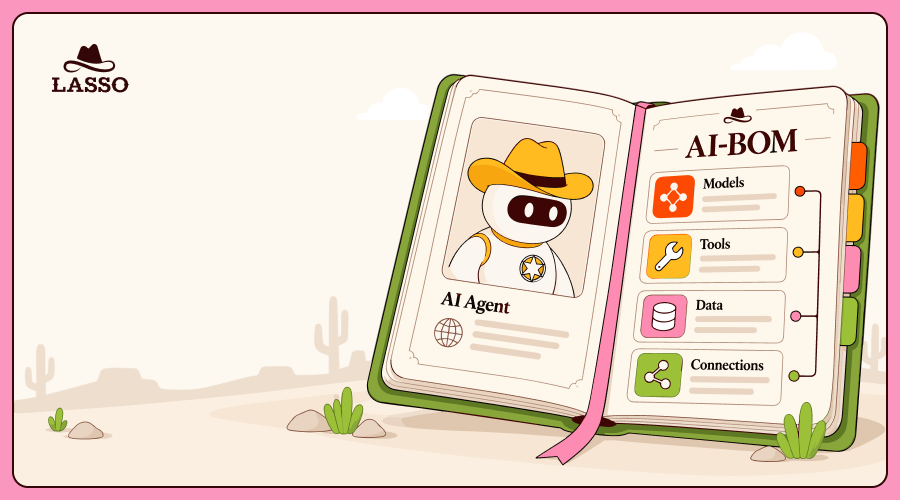
- AI-BOM Discovery Across Every LLM and Agent. Lasso builds a continuously updated inventory of every model, agent, and integration in use across cloud providers, CI/CD pipelines, and individual deployments. This is the foundation everything else runs on.
- AI-SPM and Posture Gap Detection Across LLM Deployments. Once assets are discovered, Lasso assesses each one against expected security posture. It flags missing guardrails, misconfigurations, and gaps in protection.
- Automated Red Teaming. Recon, static, multi-turn, and bespoke high-agency attacks run against every application before production and on every subsequent change, without requiring anyone to manually schedule a test.
- AI Detection and Response With Intent-Based Behavioral Analysis. Runtime monitoring tracks behavior, surfacing when an agent's actions or a model's outputs deviate from its intended purpose.
- Inline Runtime Enforcement and Policy Adaptation. Findings from red teaming and detection feed directly into runtime policy. This closes the loop between identifying a vulnerability and actively blocking it, with policies that adapt as new findings emerge.
Get Ahead of AI Risk Before It Reaches Production
AI observability is the critical visibility layer that makes everything else in this article possible:
- Catching prompt injection before it escalates
- Tracing what an agent actually did across a multi-step workflow
- Proving compliance when a regulator asks for the audit trail
Red teaming finds what's exploitable before an attacker does. Runtime monitoring and enforcement make sure nothing exploitable stays that way for long.
Lasso ties discovery, red teaming, and runtime protection into one continuous loop, so your AI security posture doesn't lag behind how fast you're shipping.
See it on your own applications. Book a demo to find out what's actually running in your environment and what's exploitable in it.
FAQs
What is the difference between AI observability and AI governance?
How can organizations scale AI observability across multiple AI applications and agent workflows?
What role does AI observability play in meeting EU AI Act and NIST AI RMF compliance requirements?
How does Lasso help security teams monitor enterprise AI activity without slowing down development?
.png)
.png)

Trusted Security for a World Run by AI