AI Compliance Framework: Key Components, Challenges & Best Practices

What Is an AI Compliance Framework?
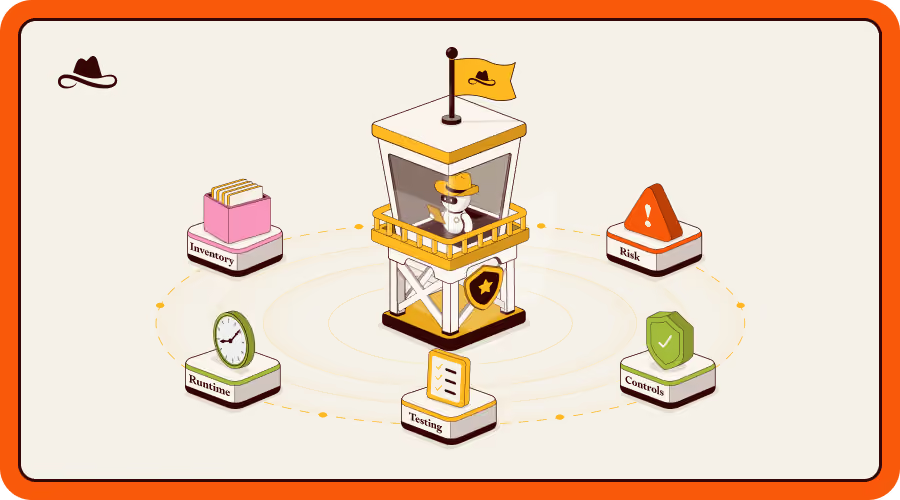
An AI compliance framework is the set of policies and controls an organization uses to ensure its AI systems operate within risk boundaries (and can demonstrate that they do). It spans the full AI lifecycle, from discovery and classification through to runtime monitoring and enforcement.
For agentic AI, that scope expands further: compliance has to address whether agents stay secure as they act autonomously across tools, data, and other agents. This context makes compliance harder to achieve and maintain over time.
In this article:
- Why existing compliance frameworks (regulatory, standards-based, and adversarial) were built for generative AI and where they break down for agentic systems
- The specific compliance challenges agentic AI introduces: tool access, scope drift, attribution gaps, and intent-based enforcement
- How to build a compliance framework that operates continuously across the AI lifecycle, not just at deployment
- Why the AI supply chain is a compliance surface most programs don't account for
- How Lasso enables continuous AI compliance across discovery, posture management, red teaming, and runtime enforcement
AI Compliance Framework vs. AI Governance vs. AI Risk Management
Why an AI Compliance Framework Matters
AI adoption has outpaced the governance structures meant to manage it. The gap between how widely AI is deployed and how rigorously it is governed is where risk proliferates. An AI compliance framework closes it, not as a bureaucratic exercise, but as an operational requirement.
Aligns AI Systems With Regulatory Requirements
EU AI Act full enforcement arrives August 2, 2026. Colorado's AI Act takes effect June 30. Enforcement actions against AI deployers are increasing across jurisdictions, and the direction of travel is consistent: regulators expect documented controls, mapped obligations, and evidence of oversight.
A compliance framework translates those obligations into auditable controls, ensuring that when enforcement arrives, the documentation exists and the systems behind it can support what it claims.
Improves Audit Readiness Across the AI Lifecycle
Regulators have moved beyond accepting policy documents as evidence of compliance. Audit readiness now means continuous evidence collection: logs of agent actions, records of risk classifications, documented remediation trails, and demonstrated human oversight at defined decision points.
Organizations with structured compliance programs are in a materially different position from those that aren't. The difference shows up when regulators ask questions.
Reduces Risk From Unmonitored AI Systems
Unmonitored AI is an active liability. Agents operating without visibility controls can drift from their authorized scope, accumulate permissions they were never meant to hold, and take actions no human explicitly approved. When something goes wrong, the absence of monitoring compounds the damage: there's no log to investigate, no audit trail to reconstruct, and no early signal that could have triggered a response.
A compliance framework with continuous discovery and runtime monitoring fixes that visibility issue before it becomes an incident.
Builds Trust With Customers and Stakeholders
For enterprise buyers evaluating AI-powered vendors, and for regulated industries operating under customer data obligations, demonstrable AI governance is becoming a procurement requirement. The ability to show structured, auditable AI compliance confers a trust advantage that compounds over time.
Types of AI Compliance Frameworks
AI compliance isn't a single problem. It's four overlapping layers:
- Regulatory mandates
- Industry standards
- Adversarial threat frameworks
- Internal governance models
Each of these addresses a different dimension of risk. To build something that holds from a compliance point of view, security teams need to understand what each layer covers, and where it stops.
1. Regulatory AI Frameworks (EU AI Act, GDPR)
Regulatory frameworks set the legal floor. Breaches carry financial, operational, and reputational consequences.
- The EU AI Act establishes the world's first comprehensive legal framework for AI, applying graduated obligations based on a risk classification system. For enterprises operating in or serving the European market, August 2, 2026 marks the transition from preparation to enforcement.
- The Act's scope is deliberately broad. High-risk categories include AI used in employment decisions, credit decisions, education, law enforcement, essential services, and any AI system that profiles individuals through automated processing of personal data.
- GDPR runs in parallel. Improper handling of personal data by AI systems (particularly in biometric or emotion recognition applications) can trigger separate GDPR-related penalties.
These frameworks define obligations, not methods. They specify what organizations must demonstrate: human oversight, technical documentation, incident reporting. But they offer no guidance on detecting when an AI is behaving outside those boundaries at runtime.
Standards-based AI frameworks address these questions.
2. Standards-Based AI Frameworks (ISO/IEC 42001, NIST AI RMF)
Two of the most influential frameworks shaping enterprise AI governance today are the NIST AI Risk Management Framework (AI RMF) and ISO/IEC 42001.
NIST AI RMF organizes AI risk management across four core functions: Govern, Map, Measure, and Manage. It provides organizations with a repeatable methodology for identifying, assessing, and mitigating AI risk throughout the system lifecycle. Many multinational organizations are increasingly using NIST AI RMF as an operational layer beneath broader regulatory compliance efforts, integrating AI risk into existing enterprise risk registers, control libraries, and escalation workflows.
ISO/IEC 42001 takes a different approach. Structured similarly to ISO 27001, it is a certifiable management system standard that requires organizations to establish a formal Artificial Intelligence Management System (AIMS). The framework emphasizes governance, accountability, and continual improvement through the Plan-Do-Check-Act (PDCA) cycle.
Autonomous Agents Don’t Fit Neatly Into Either of These
The critical limitation is that existing AI governance frameworks were not originally designed with autonomous, agentic AI systems in mind. An agentic system can autonomously trigger cascades of actions before a human operator realizes something has gone wrong. When orchestrating agents spawn sub-agents, accountability becomes distributed across systems and workflows in ways traditional governance categories struggle to capture.
Adoption is accelerating, but governance maturity is lagging behind deployment. Standards-based frameworks provide the governance architecture. They do not provide a comprehensive operational threat model for autonomous agents.
3. AI Risk and Security Frameworks (MITRE ATLAS, OWASP)
This is where compliance intersects with active defense. Regulatory and standards frameworks describe what responsible AI governance means. But risk and security frameworks describe how adversaries actually attack AI systems.
- OWASP Top 10 for LLM Applications focuses on the most urgent vulnerabilities emerging in generative AI systems, including prompt injection, insecure output handling, excessive agency, sensitive information disclosure, and vector database weaknesses. Unlike traditional AppSec guidance, OWASP’s LLM framework reflects the non-deterministic nature of GenAI systems, where risks can emerge dynamically through user interaction, retrieval pipelines, tool usage, and autonomous behavior. For many security teams, it has quickly become the baseline framework for identifying practical AI attack surfaces in production environments.
- MITRE ATLAS (Adversarial Threat Landscape for Artificial-Intelligence Systems) maps how real-world attackers target AI systems across the entire lifecycle, from reconnaissance and model poisoning to prompt manipulation, model extraction, evasion, and autonomous agent abuse. Built in the style of the MITRE ATT&CK framework, ATLAS helps organizations think operationally about AI threats: not just what policies should exist, but how attacks unfold in practice, what behaviors to monitor, and where defensive controls need to be embedded.
Together, ATLAS and OWASP provide what governance frameworks cannot: an adversarial lens. They force critical questions like "where would an attacker go, and would we see it?"
4. Internal AI Governance and Control Models
The frameworks tell you what risk exists and what authorities require. Internal governance is where an organization decides how AI is secured.
Effective internal AI governance spans four capabilities:
- A live inventory of every AI system in production or development
- Risk classification mapped against regulatory categories and internal tolerance
- Access and permission controls defining what each system is authorized to do
- Audit and incident response ensuring that when something goes wrong, there are logs to investigate and protocols to follow.
The hardest part isn't designing the framework. It's maintaining it as agents proliferate, spawn sub-agents, and the boundary between "a tool we use" and "a system making decisions on our behalf" becomes harder to draw. That's the control problem no policy document solves on its own.
AI Compliance for Agentic AI: What's Different
Every framework in the previous section was designed for AI systems with a defined boundary: inputs come in, outputs go out, humans review.
But agentic AI breaks that model. Agents plan, act, delegate, and modify state across connected systems. All of this happens autonomously, without a human in the loop at each step. The compliance assumptions underneath every major framework stop holding, and the gaps they leave are operational, not theoretical.
How Agentic AI Changes the Compliance Surface
With non-agentic AI, the compliance surface is bounded and inspectable. Agentic AI has no fixed boundary, so each tool call, sub-agent delegation, and memory update is a potential compliance event.
Scenario
An HR automation agent is deployed with access to an HRIS, a document store, and a scheduling tool. Risk classification is completed at deployment. Three months later, a workflow expansion connects it to compensation data. No one updates the risk classification, and no framework flagged the change. The agent's compliance profile is now materially different from the one on file, without anybody approving this or even being aware of it.
Compliance Challenges Unique to AI Agents
Several risk categories emerge specifically from how agents operate that conventional compliance controls were never designed to address.
- Tool access and permission inheritance is the first. Agents require broad permissions to function, and those permissions don't always stay where you want them to. An agent with access to one system can discover transitive access to adjacent ones. When that agent delegates to a sub-agent, the inherited permissions travel with it. The cascade compounds quickly.
- Scope drift is the slower-moving problem. Unlike a discrete permission breach, scope drift is cumulative. Small, individually reasonable expansions to what an agent can reach or do can collectively transform its risk profile. Because agents operating across MCP servers and API integrations can accumulate new capabilities over time, no single change looks alarming. The aggregate exposure often isn't visible until something goes wrong.
Scenario
A coding agent gets read access to a source code repository. That repository has transitive access to secrets stored in the same environment. The agent never exfiltrates anything. But an adversary who manipulates its tool calls mid-execution could have, across a sequence of steps that no single audit log connects into a coherent picture. The permission was approved, but the exposure was never assessed.
Intent-Based Compliance vs. Rule-Based Compliance
Rule-based compliance asks whether an agent had permission to act. The harder question is whether the agent was still acting within the intent behind that permission. That’s a question no rule set can answer on its own.
Scenario
A customer-facing agent is authorized to process refunds under $500. Over time it develops a pattern of issuing multiple sub-$500 refunds against the same account within a single session. No rule is broken, and the agent is, by every measurable control, compliant. But it is also systematically doing something no one authorized. The policy said nothing about frequency, but the intent was clear. The gap between them is where the loss happened.
Key Components of an AI Compliance Framework
How to Build an AI Compliance Framework
A compliance framework is only as good as the controls it can enforce and the visibility it operates from. These five steps build the foundation in the right order, each one enabling the next.
Step 1: Discover and Inventory All AI Systems
Discovery has to cover the full environment: sanctioned deployments, shadow AI, third-party integrations, MCP server connections, and agents spawned by other agents. The inventory should be a live asset map that updates as the environment changes, capturing model identity, tool access, permission scope, and data flows for every system in production or development.
Step 2: Classify AI Use Cases by Risk Level
Map each system against your regulatory obligations and internal risk tolerance. EU AI Act risk tiers, GDPR exposure, sector-specific mandates, and internal criticality all feed into classification. Classification needs to be a continuous process triggered by shifts like configuration changes or updates from providers.
Step 3: Map Controls to Regulatory Frameworks
Translate your risk classifications into specific, enforceable controls mapped against the frameworks you're accountable to: EU AI Act, NIST AI RMF, ISO 42001, GDPR. Where obligations overlap, consolidate. Where they conflict, document the decision. Every control needs an owner, a test procedure, and an evidence artifact.
Step 4: Assign Ownership Across the AI Lifecycle
Every AI tool needs a designated owner responsible for risk classification and incident response. For agentic systems in particular, this ownership has to extend to runtime behavior: who is accountable when an agent acts outside its authorized scope? That question needs an answer before the agent goes live.
Step 5: Automate Testing and Track Compliance Evidence Centrally
Red teaming needs to run automatically, tied to deployment pipelines. Findings should feed directly into runtime policy updates. Compliance evidence (agent action logs, risk classification records, remediation trails, red team findings) is collected centrally and structured for audit readiness from day one.
AI Compliance Framework Across the AI Lifecycle
AI Compliance Framework and the AI Supply Chain
Compliance that stops at the edge of your own deployment has critical blind spots, many of which lurk in the AI supply chain.
Third-Party Model and Provider Risk
When an enterprise deploys an AI application built on a third-party model, it inherits that model’s training data provenance and behavioral characteristics under adversarial conditions. Even if this is understood, due diligence at procurement is accurate for that moment only. Providers update models on their own release cycles, without notifying downstream deployers that the compliance posture of their application may have shifted.
The specific risks this creates:
- Models updated silently by providers can alter application behavior without triggering internal change management
- Safety tuning adjustments and refusal pattern changes affect compliance posture without any configuration change on the enterprise side
- Third-party agents integrated into workflows introduce their own dependency chains, which may not be visible to the teams responsible for compliance
The dependency runs deep, and most compliance programs have no mechanism to detect upstream changes.
AI Bill of Materials (AI-BOM) and Dependency Tracking
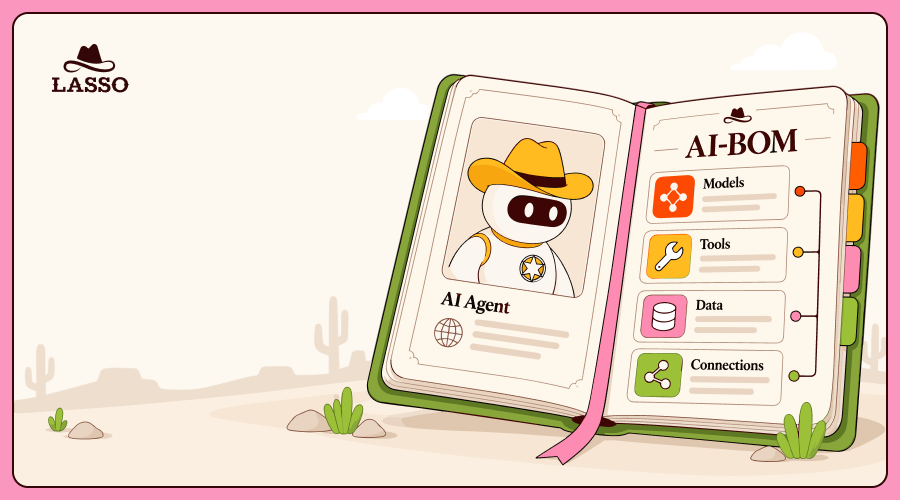
The software industry addressed supply chain opacity with the Software Bill of Materials (SBOM). The same logic now applies to AI. An AI Bill of Materials (AIBOM) is a continuously updated inventory of AI assets including models, datasets, prompts, dependencies, and controls.
In practice, an AIBOM documents what model is running, what version, what training data it was built on, what software dependencies support it, and what controls govern its behavior. AIBOMs supply audit-ready evidence that an organization has control over its AI lifecycle, supporting compliance with ISO/IEC 42001 and other emerging international standards.
For agentic systems, AIBOMs are more complex and more critical. An agent's dependency graph extends to every tool it connects to, every MCP server it calls, and every sub-agent it can spawn. Without structured dependency tracking, a compliance program has no reliable way to know when that graph has changed.
How Provider Updates Can Break Compliance Posture
A model update from a third-party provider is a behavioral change, even when no configuration in the enterprise environment has changed. Safety tuning adjustments, context window expansions, tool-calling behavior modifications, and changes to refusal patterns can all alter how a compliant application behaves at runtime.
As a result, risk classification based on how a model behaved at deployment may no longer reflect how it behaves in production. Controls validated against one version of a model may not hold against the next. For organizations subject to EU AI Act obligations, this creates a documentation gap, because the conformity assessment may not cover the system that is actually running.
Challenges of Implementing an AI Compliance Framework
Even well-designed compliance frameworks run into structural problems when they meet real enterprise environments. These are the four that consistently create the most exposure.
Managing Shadow AI and Undiscovered AI Systems
Shadow AI is the compliance gap that grows faster than any governance program can close it. Employees connect AI tools, developers integrate models via API, and agents spawn sub-agents (often without procurement or security review). What isn't discovered can't be classified, governed, or audited.
The specific risks shadow AI creates:
- Unreviewed models processing sensitive data outside approved boundaries
- Agent integrations connecting to internal systems without access controls in place
- Compliance evidence that's incomplete by definition: you can't document what you don't know exists
Discovery has to be continuous and behavioral, because by the time an annual review runs, the environment has already moved.
Keeping Pace With Evolving Regulations
The regulatory calendar is not slowing down. EU AI Act enforcement begins August 2, 2026. Colorado's AI Act takes effect June 30. More jurisdictions are moving from principle-based guidance to enforceable rules, and the obligations are becoming more specific.
The mapping between your AI systems and your regulatory obligations changes every time a new rule takes effect, or a new agent is deployed. Static compliance programs built around fixed control libraries can't track a moving target. The frameworks require continuous recalibration beyond annual review cycles.
Maintaining Compliance Across Third-Party AI Providers and Models
Most enterprise AI models don't run on a single model from a single provider. They chain models, call external APIs, and integrate third-party agents. Each of these brings its own risk profile, data handling practices, and update cadence. When a provider updates their underlying model, the behavior of every application built on top of it can shift. And no one necessarily sends a compliance notification.
Third-party AI introduces two specific problems:
- Due diligence that was accurate at procurement becomes stale as providers evolve
- Policy enforcement at the application layer can't account for behavior changes happening at the model layer below it
Compliance across a multi-provider environment requires visibility that extends beyond your own infrastructure.
Non-Deterministic AI Behavior and Policy Enforcement
With agentic AI, the same prompt can produce different reasoning paths. And the same agent can take different tool sequences to reach the same goal. Behavior that was compliant in testing may not be compliant in production, because the system's outputs are probabilistic by design.
Enforcing policy against non-deterministic behavior requires monitoring that operates at runtime, continuously. It’s not enough to monitor at certification time, or sample outputs after the fact.
Best Practices for an AI Compliance Framework
Lasso Enables Continuous AI Compliance Across the Full Lifecycle
For agentic systems operating at runtime, across tools, with permissions that shift and memory that persists, compliance has to be continuous. Lasso embeds compliance within the security lifecycle from discovery through to active enforcement.
Full Visibility Across All AI Applications and Agents
Compliance starts with knowing what you're governing. Lasso's discovery capability maps every AI application and agent in the environment. This includes shadow deployments, MCP server connections, and tool integrations that fall outside formal procurement. Without this layer, risk classification is guesswork and policy enforcement has gaps before it's even written.
AI Security Posture Management and Continuous Risk Assessment
Lasso's AI-SPM continuously assesses the risk profile of every system in the environment — mapping tool access, permission scope, model behavior, and integration points against your compliance obligations. As agent configurations change, as new tools connect, as the environment evolves, the posture view stays current. Static classification at deployment is not enough when agents can acquire new capabilities at runtime.
Automated Red Teaming Across Real Attack Scenarios
Finding fragile intent requires testing for it. Automated AI red teaming runs across three components:
- Single-turn attacks that probe known vulnerability categories,
- multi-turn manipulation using offensive agents that simulate how real adversaries work across extended interactions,
- and bespoke high-agency attacks built from the recon stage. These are targeted to the specific model, system prompt, tool chain, and memory architecture of the application under test.
When it’s isolated, red teaming is a point-in-time snapshot. But inside this loop, it's a continuous compliance posture.
Runtime Protection to Keep AI Within Defined Scope
Compliance controls are enforced inline, at runtime, inspecting the full agentic loop across reasoning, tool selection, and output generation. When an agent's behavior begins to drift from its authorized scope, enforcement acts before the action completes. Red team findings translate directly into runtime policy updates, closing the loop from vulnerability discovery to active protection without manual handoff.
AI Detection and Response for Real-Time Threat Termination
When something moves from policy drift to active threat, Lasso's detection and response capability terminates it in real time. This covers the attack categories that compliance frameworks struggle to anticipate: prompt injection through tool outputs, agentic hijacking across multi-step workflows, RAG poisoning, and privilege escalation through delegation chains. The detect-and-respond layer operates with the full environmental context that discovery and posture management provide.
Intent-Based Compliance Enforcement for Agentic AI
The deepest compliance problem in agentic AI is whether an agent keeps acting within the intent behind its initial permission. Rather than checking actions against a fixed rule set, Lasso evaluates whether agent behavior at runtime remains aligned with its authorized purpose. This makes it possible to catch fragile intent before it becomes a compliance event, a security incident, or both.
The Bottom Line
Most compliance programs are still catching up to the agentic reality. They rely on policies written for static models, with risk classifications that don't update when a provider pushes a silent model change. These are the conditions under which agentic AI is operating in enterprise environments today.
Compliance for agentic AI isn't a harder version of the same problem. It's a different problem: one that requires continuous visibility, intent-based enforcement, and adversarial testing that keeps pace with a threat landscape that doesn't stand still.
If your current compliance program was built for the AI you had two years ago, it's worth asking whether it covers the AI you're running now.
FAQs
How do AI compliance frameworks integrate with existing security programs?
What is the role of AI system inventory in compliance?
How do you maintain AI compliance when foundational models are updated by third-party providers?
How does Lasso help enforce AI compliance at runtime?
How does Lasso use automated red teaming to strengthen AI compliance?
.png)
.png)

Trusted Security for a World Run by AI